Kirstie Drummond Papworth is a Psychologist and Executive Director at London Business School. She has Masters Degrees in Psychology and Behavioural Change, and is the author of ‘Compassionate Leadership for Individual and Organisational Change’, a finalist in the Business Book Awards and the Chartered Management Institute Book Awards
Self-compassion is an indispensable leadership resource. Far from being a self-indulgent practice, it is a catalyst for resilience, emotional regulation, individual well-being, and sustained leadership performance.
Compassion is a response to suffering, and it is important to acknowledge that everyone suffers regardless of job title or status, albeit in different ways and at different times; a pressured, unsupportive working environment; a toxic boss; an overwhelming, undermining colleague; the daily juggle of responsibilities at home and work. Redundancy, bereavement, illness. All of these are everyday examples of suffering, and no one is immune.
In simplest terms, self-compassion can be thought of as an awareness of our suffering and a desire to alleviate such distress.
Writer and monk Jack Kornfield’s statement, “If your compassion does not include yourself, it is incomplete” underscores the foundational role self-compassion plays in both professional and personal growth. While compassion for others is increasingly emphasized in leadership, self-compassion remains relatively under-utilized. This oversight is costly, as leaders who lack self-compassion are more prone to burnout, are likely to be less effective in developing and sustaining healthy organizational cultures, and have limited resilience in the face of adversity.
This article examines self-compassion as a means of addressing our suffering, its practical application in leadership, and its benefits for individual and organizational well-being. Drawing on both established frameworks and emerging research, it offers actionable insights for practically integrating self-compassion into everyday leadership practice.
Self-Compassion: Evidence and a Framework Self-compassion is finally being acknowledged as a formidable means of enhancing psychological resilience, reducing stress and improving overall well-being. These outcomes therefore make self-compassion an appealing and useful leadership resource.
Mindfulness allows us to notice thoughts and feelings, without becoming overwhelmed by them.
Recent research has repeatedly demonstrated the impact of self-compassion. Notable findings include brain imaging studies which reveal that self-compassion meditations activate areas associated with emotional regulation, such as the insula and amygdala. Another study, where participants simply imagined being the recipient of compassion, showed that these visualizations resulted in lower levels of cortisol, the primary stress hormone. In a rather wonderful experiment, Kaurin et al found that firefighters who had been exposed to significant trauma reported lower levels of depression when they practiced self-compassion. Repeated studies have found that compassion-focused interventions promote prosocial behaviours, which in turn help to improve team dynamics and cooperation at work, and can even reduce burnout in nursing staff.
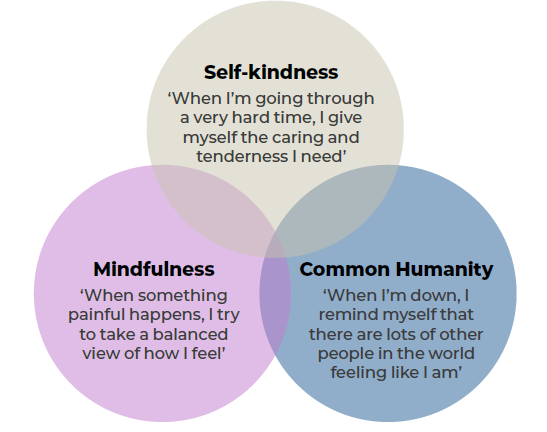
As this increasing body of evidence illustrates, self-compassion is a powerful approach to dealing with stress, difficult emotions and even trauma. In order to benefit, it is useful to start by understanding what self-compassion actually is. In simplest terms, self-compassion can be thought of as an awareness of our suffering and a desire to alleviate such distress. The idea of practicing self-compassion might seem a little strange at first, particularly in a leadership context, and so a framework can prove useful. Psychologist and Professor Kristen Neff’s widely accepted construct of self-compassion is comprised of three interconnected elements: mindfulness, common humanity, and self-kindness. I will now describe each of these in turn:
1. Mindfulness Although recent obsessions with mindfulness can be off-putting to many, Neff’s definition is quite specific. In her approach, mindfulness involves acknowledging one’s suffering without over-identifying with it or becoming overwhelmed. Such mindfulness allows leaders to stay present, observe their thoughts and emotions non-judgementally, and avoid impulsive reactions that would be unhelpful in the workplace. This is therefore clearly a critical skill for any leader as they manage their way through challenge and complexity.
Leaders who practice self-compassion avoid the paralysis of perfectionism or the urge to fight or flee fear, and so are better placed to consider options and take considered actions.
2. Common Humanity This dimension reminds leaders that suffering is universal. Although in different ways and for a myriad of reasons, we all have moments of difficulty. Instead of asking “why me?” when things go wrong, this element encourages a recognition that “why not me?” might be a more useful question. This acceptance that no one entirely escapes suffering fosters a broader perspective and more regulated emotional balance. Understanding this shared nature of adversity can also support leaders to avoid feelings of isolation during difficult times, thus enhancing their capacity to cope during adversity and to empathize with their colleagues.
3. Self-Kindness Self-kindness entails treating ourselves with the same gentleness and understanding that we might more typically extend to others. This practice can counterbalance tendencies toward excessive self-criticism, which can hinder decision-making and well-being. By practicing self-kindness, leaders model emotional intelligence and create a culture of psychological safety within their teams. This is often the aspect of self-compassion which people find most difficult, perhaps through lack of practice; if this is the case, think about what you might say to a friend or what they might say to you.
This framework is appealingly simple to understand and apply, yet self-compassion remains an oddity in leadership development. In a leadership context, self-compassion suffers from a reputational problem. In a tough organizational life, it might be considered that such compassion for ourselves is a sign of weakness; those who cannot stand the heat should get out of the kitchen.
Where a growth mindset is prevalent, collaboration and innovation are more common, and employees report feeling more dedicated and empowered.
Self-Compassion's Reputation Problem Despite its well-documented benefits, self-compassion still faces resistance, especially in competitive corporate cultures where ‘being tough’ is often equated with competence. Prevailing cultural norms in many organizations often value self-reliance over introspection, creating a stigma around practices perceived as ‘soft’. Misconceptions equate self-compassion with vulnerability or indulgence or just view it as unnecessary for some. Let’s consider some of these concerns:
Self-Pity Self-compassion can often be confused with self-pity. Sometimes, things just do not go our way, we have a run of bad luck or life can just feel like one long, hard slog. When we become preoccupied with such troubles and end up feeling sorry for ourselves, this is self-pity. Sometimes - and for a brief period - self-pity can be warranted, and without it, we might miss gratitude and joy when life treats us more gently. But when we wallow in self-pity, we are largely viewing ourselves as victims of circumstances beyond our control. In psychologist Julian Rotter’s terms, we would be exhibiting an external, rather than an internal, locus of control. Self-pity breeds passivity and excessive rumination, and leaders who remain stuck in such a state risk undermining their capability, credibility, and emotional stability.
By way of contrast, self-compassion emphasizes understanding and acceptance, resulting in better emotional regulation and resilience. Mindfulness allows us to notice thoughts of self-pity, without becoming overwhelmed by them. Common humanity reminds us that everyone struggles and feels self-pity sometimes, and self-kindness encourages us to treat ourselves with the gentle kindness that we would offer a friend.
Self-Esteem Some leaders may believe that improving their self-esteem reduces the need for self-compassion. Self-esteem refers to how we perceive our worth or value, and this perception is often shaped by the opinions and actions of others throughout our lives. Our levels of self-esteem impact almost every aspect of our lives, from the quality of our relationships to our decision-making abilities and our overall sense of well-being. A moderate level of self-esteem can, of course, bolster our confidence and is correlated with positive well-being. However, if our self-esteem is too low then we are likely to suffer in terms of our mental health, relationships, and resilience. At the other extreme, when self-esteem is too high, this can quickly lead to defensiveness and narcissism.
Compassion strengthens social connectedness, and the importance of this cannot be understated; poor social connectedness is worse for our physical health than obesity, heart disease, and smoking.
The main issue with self-esteem during times of difficulty is that when we are feeling low, accessing what we most like about ourselves is frustratingly difficult to do. In contrast, self-compassion is accessible even - nay, particularly - during periods of low self-worth, and encourages intrinsic motivation for improvement. Leaders who practice self-compassion, rather than relying on self-esteem, can recover more quickly from setbacks, whilst also maintaining humility and inspiring trust.
Self-esteem wants us to be better than average, and to achieve this we must therefore evaluate ourselves to be better than others. We must talk ourselves up while putting others down. More usefully, self-compassion does not require an evaluation against others, and so our kind, considered focus can remain on ourselves rather than on the perceived flaws of others.
Self-Criticism Being our own toughest critic is worn as a badge of honour in some organizations especially with those who might consider self-compassion as a weakness. In the words of fictional yet relatable CJ, boss of Reginald Perrin, “I didn’t get where I am today by being nice”. Of course, some self-criticism can be useful. It helps us to change behaviours or habits we dislike in ourselves and, when used in moderation, can assist us in assessing our achievements and actions. Excessive self-criticism, however, can be crippling, triggering stress responses and impairing mental health.
Reframing statements from overly critical “I’m a failure” to “I made a mistake, but I can learn from this” transforms self-talk into a tool for growth and progress.
We often criticize ourselves more harshly than we would do others. Noticing such excessive self-criticism is a first step towards having a more compassionate attitude towards ourselves. Self-compassion mitigates the negative effects of self-criticism by fostering a more balanced perspective and reducing cortisol levels. Leaders who practice self-compassion avoid the paralysis of perfectionism or the urge to fight or flee fear, and so are better placed to consider options and take considered actions.
Being clear on what self-compassion is and noting how it is more useful than self-criticism, self-esteem, or self-pity, offers leaders an opportunity to apply self-compassion with both understanding and clarity. Self-compassion is a powerful approach, offering leaders personal, professional, and organizational benefits.
Benefits of Self-Compassion for Leaders Many leaders remain unaware of self-compassion’s tangible benefits, dismissing it as irrelevant to professional success, and even those with some awareness may view self-compassion practices as low-priority, despite their long-term benefits. Particularly in a leadership context, there are numerous benefits of self-compassion, including emotional regulation, resilience after setbacks, a more innovative and collaborative mindset, and improved social relationships. Let us outline these in more detail, then offer practical ways to develop leadership self-compassion.
Self-compassion is a useful aid to emotional regulation. It enhances our ability to stabilize our moods, fosters optimism, and reduces our susceptibility to stress. Simply put, leaders who practice self-compassion are better equipped to make thoughtful decisions under pressure. Emotional regulation generates trust, which also supports teams to navigate crises more effectively.
Resilience is the ability to recover from setbacks and is a vital skill for leaders navigating complex environments. This ability is critical in environments characterized by uncertainty and rapid change and, given the disproportionate impact of leadership, is an increasingly crucial leadership competency. Self-compassion enhances individual resilience levels by reducing rumination and enabling leaders to quickly bounce back from adversity.
The idea of a growth, as opposed to a fixed, mindset comes from psychologist Carol Dweck’s work in this area. People who believe that their abilities and talents can be enhanced through their actions, smart strategies, and feedback are said to have a growth mindset. Conversely, those who believe talent is fixed, even bestowed upon them, are considered to have a fixed mindset. The benefits of a growth mindset for individuals include better performance on tests versus those with more fixed mindsets, increased intellectual abilities, and more energy being allocated to learning. In organizations where a growth mindset is prevalent, collaboration and innovation are more common, and employees report feeling more dedicated and empowered. Leaders with growth mindsets inspire similar attitudes within their teams, driving innovation and collaboration. Juliana Breines and Serena Chen have shown in their research that practicing self-compassion can result in the adoption of a growth mindset. This reinforces the importance of self-compassion for leaders; organizations led by such leaders are more agile and adaptive to market demands. Self-compassion, then, is good for leaders and for the results of the organizations they lead.
Practicing self-compassion has also been shown to bolster social relationships, promoting trust and cooperation, as well as fostering feelings of belongingness. These attributes are critical for leaders whose aim is to cultivate high-performing, cohesive teams. By showing appropriate vulnerability and self-compassion, leaders create inclusive, psychologically safe environments. It might sound fairly obvious to note that compassion strengthens social connectedness, but the importance of this cannot be understated; poor social connectedness is worse for our physical health than obesity, heart disease, and smoking. Compassion, it seems, can even save our lives.
Practical Applications for Leadership
Addressing the reputational barriers and applying the insights from research requires a reframing of self-compassion as a critical, strategic leadership asset rather than a sign of fragility. Utilizing evidence-based techniques and integrating self-compassion into personal development practice can help leaders develop and thrive, together with the colleagues and cultures they lead. This approach is closely aligned with Dalton's definition of leadership personal development as being the process of finding sustainable health and well-being.
Below are six practical ways in which leaders can start to develop their self-compassion; these are adapted from my book, Compassionate Leadership for Individual Organizational Change (2023). It is worth bearing in mind that these are practices, so a consistency of approach will give better results than occasional grand gestures.
Practice Self-Compassion Next time you make a mistake or do not live up to your expectations, practice the three steps of self-compassion: Mindfully become aware of your feelings without becoming overwhelmed, remind yourself that everyone makes mistakes and suffers, and be as gentle on yourself as a good friend would be to you. Remember, through this practice, you will be improving your overall well-being and your leadership resilience.
Daily Self-Compassion Meditation Through my psychology research on the impact of self-compassion meditations on leaders, I found that listening daily to a short self-compassion meditation significantly reduced the participants’ self-reported levels of stress, anxiety, and depression. The practice of such meditations, even when as brief as three minutes long, can recalibrate leaders’ stress responses and allow them to set a calm, focused tone for their day.
Adjusting Self-Talk
Leaders often engage in self-critical inner dialogue, particularly when things go wrong or if they consider self-criticism as having led to their successes to date. Reframing statements from overly critical “I’m a failure” to “I made a mistake, but I can learn from this” transforms self-talk into a tool for growth and progress. Reflective writing exercises can help identify patterns of self-criticism and develop more constructive alternatives.
Writing a Self-Compassion Letter
Acknowledging imperfections through writing oneself a compassionate missive can aid self-acceptance, even if it feels like a strange exercise at first. A self-compassion letter-writing exercise encourages leaders to treat themselves as they would a trusted colleague facing similar challenges. Start the letter by addressing it to yourself and bring to mind a difficult situation you would like to address; keep yourself safe in your choice of topic. Using the structure of the three aspects of self-compassion as a guide for three paragraphs can ensure you are practicing self-compassion rather than self-pity. If you choose to, it can also be useful to add a small action that you will take as a result of your contemplation about the specific scenario. Such self-compassion letters can also serve as enduring reminders of resilience and self-worth, and will often elicit surprising themes and emotions.
Leveraging Compassion Imagery
This technique effectively hacks our brain's inability to entirely distinguish between real and imagined. Being a recipient of compassion activates neural pathways associated with emotional soothing, and imagining a compassionate source soothing us reduces our stress responses. This simple technique, where we imagine receiving compassion for a few quiet minutes is shown to reduce anxiety and enhance our focus. Leaders can use such imagery techniques during high-pressure scenarios to enhance their confidence and clarity.
Creating a Self-Compassion Plan
Leaders can develop personalized self-compassion plans by identifying triggers of self-criticism and proactively applying techniques such as meditation, practicing self-compassion during difficult times, and addressing repeating patterns of behaviour and emotion. Such plans allow for a deeply reflective approach to personal development and serve as an actionable road map for or during stress periods.
Conclusion
By integrating self-compassion into their lives, leaders not only enhance their well-being but also model health behaviour that benefits their colleagues and wider organizations.
The evidence is clear: self-compassion is beneficial to our wellbeing, resilience, relationships, leadership impact, and organizational results. Weaving self-compassion practices into our daily lives enables us to sustainably support ourselves, as well as to more effectively lead others.