




Motivation. We have been doing it all wrong. Yes, we have successful businesses. We have individuals who have thrived financially, but we are also facing a crisis in human motivation and well-being. Work is killing us. Slowly, but surely.
As we start to emerge from the COVID-19 isolation and lockdown, we enter a world, blinking into our surroundings, that looks the same and yet, everything is different. The biggest remote working experiment has just been run. Decisions and behavioral shifts that would have taken months, years even, to implement were made in a matter of days. But what have we learned? What opportunities will be embraced to change the way we live and work? This global crisis with its long-reaching, long-lasting effects affords us the opportunity to reset. To imagine and build a better working world. Well before the outbreak of the pandemic, my colleagues, and many other leading researchers were calling for new ways of working. To stop trying to fit human beings into the workplace and instead, create workplaces fit for humans. The science, data, and empirical research screamed with the reasons why we needed to change. And yet, the take-up and mindset shift was slow to non-existent in some organizations. The well-being, inclusion, engagement, and cultures of trust agendas, beaten on the drums of many leadership and people development practitioners, who could see the new way, were not strong enough to topple the age-old, yet defunct, textbook science of management wielded across policies and performance metrics.
Performance management created more sticks than rewards and the Peter Principle of leadership promotion to incompetency played out because new leaders were not given the real tools to truly understand how to motivate the humans they now supported. So if a major health crisis that has brought so much misery, suffering, and economic devastation for so many cannot open our eyes I don’t know what will.
“The definition of insanity is doing the same thing over and over again, but expecting different results.” Albert Einstein
The Zeitgeist
The industrial revolution took men from the farms to the factories and with it came tools to enhance efficiency of labor productivity. One theorist in the early 20th century was Frederick Taylor. He is seen as the founding father of the science of management, and his methodology, also known as Taylorism, was widely used. One of his core principles was that workers were motivated by money so should receive pay based on their output. And so arrived the first performance metrics. His approach was based on rational and objective argument, but whilst significant contribution was made to improving the way tasks could be achieved, Taylor failed to take into account that the core resource was not wholly rational, but instead fundamentally human. A biological system that is primarily driven by emotions. As Henry Ford, an advocate of the Taylorism methodology said:
“Why is it every time I ask for a pair of hands, they come attached to a brain.” Henry Ford
A great deal of research on human motivation and management science has since been published that moves away from Taylor’s methods, but despite this the underlying premise of so many leadership techniques and performance metrics are based on his legacy and the proverbial ‘carrot and stick’, rather than what we know, at a neurobiological level, to intrinsically motivate. Huge amounts of time and money are placed into recruiting the brightest and the best. And yet as those bright stars enter organizations, they are faced with performance metrics, policy rules, league tables, and KPIs that whilst set up with the good intention to motivate, actually inject fear and curtail and constrain performance and innovation of the talent so hotly pursued. Take for instance flexible working. Even the mention of the name often sent leaders into a tailspin. The very notion that their teams could be left to their own devices to deliver. That working from home was another way of saying, “I’ll take the day off.” So, a flexible working policy was created. A policy intended to support but in effect only served to deliver a list of rules that more often than not resulted in inflexible working. If there is one plain-as-day lesson learned from the Coronavirus lockdown, is that this belief was simply just a belief. It had no basis in fact and the reality is that human beings, given autonomy and choice, can self-organize and in fact, can deliver better.
This global crisis with its long-reaching, long-lasting effects allows us to reset. To imagine and build a better working world
“It doesn’t make sense to hire smart people and tell them what to do; we hire smart people so they can tell us what to do.” Steve Jobs
There is a leadership zeitgeist. Many believe that the way we have been leading and establishing organizational culture is right and is in fact the only way. Confirmed by, but measured completely ineffectually, the annual engagement and well-being survey. Where time lags to the publication of results, and the fact they could have been completed by individuals on a rainy Monday morning or a sunny Friday afternoon, significantly affects their response filter. Let’s blow these outdated methods out of the water, recalibrate, and bring in what we really know about the messy art of human leadership.
Health economics
The pandemic has in some ways served to highlight the already glaring problem in the way we have been working. Gallup’s ‘State of the Global Workplace’ report, shows that 85% of employees are not engaged or are actively disengaged. Whilst this figure seems staggering, it makes more sense when you see from their research that the not engaged proportion, which is 67%, aren’t the worst performers, but they are indifferent to your organization. They give their time but not the best of themselves. Ideas and energy are withheld. To quote Gallup’s report, “They likely come to work wanting to make a difference but nobody has ever asked them to use their strengths to make the organization better.” I would go one step further, to suggest that workplace environments and performance management approaches, for these individuals, are actually quashing the desire to engage and inject an undercurrent of fear. The fear of not achieving the target, the next change initiative or not reaching the assigned KPI is tied to the ultimate performance rating. This global disengaged ‘norm’ has a huge economic consequence, currently estimated at $7 trillion in lost productivity.
Very few organizations and their leaders, who influence up to 70% of the employee experience, know how to achieve true engagement
So why are we getting it so wrong? We know from many years of research into workplace engagement, that the returns are not just to the bottom line, but to the health and wellbeing of our teams. Retention improves, productivity and innovation are boosted and profits go up. We want and need engaged employees, but very few organizations and their leaders, who influence up to 70% of the employee experience, know how to achieve true engagement.
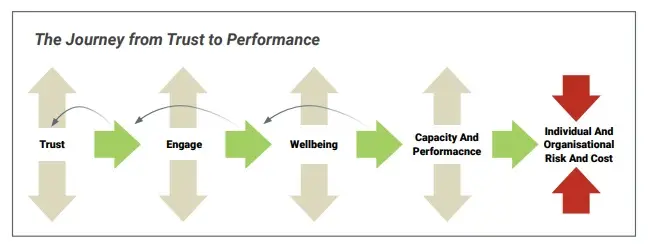
Engaged staff are 87% less likely to leave. Organizations with top-quartile engagement levels experience 70% fewer safety incidents, 17% higher productivity, 20% higher sales, and 21% higher profitability among many other positive metrics resulting from higher engagement levels. Disengaged staff make 100 times more errors than engaged staff. But, engagement is only an outcome. It is the result of the overall employee experience and the level of trust they feel in every aspect of their working lives.
And, these issues will likely only get worse before it gets better if we don’t address them head-on, right now. A recent report published in The Lancet warned that the mental health effects of the pandemic could “exceed the consequences of the 2019-nCoV epidemic itself.” And then there are the long-term effects for all of us. As Yuval Neria, professor of psychology at Columbia University, explained to CNBC, traumatic events can leave a broad and lasting mark, and not just on those most affected by the events themselves.
What do we need to sustain?
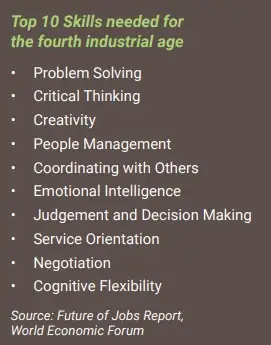
In an article in 2016 the World Economic Forum, as part of Davos 2016, laid out as they saw it the skills needed for the future of work in the fourth industrial age. The timeline for their future of work was 2020. Advanced robotics, artificial intelligence, nanotechnology, genomics, and many other technological advances will forever change our working world. Many roles from just five years ago no longer exist, and many more will disappear in the next five years. The relationship between employer and employee will shift and the gig economy will flourish. But, with this massive change in the landscape comes opportunity. New roles will appear requiring new skills and new leadership capability.
Because the one thing that all these skills have in common is that they are inherently human. Industry 4.0 needs Human Leadership 4.0. The challenge comes at this point because we have not equipped individuals, teams, and leaders in particular with the tools and knowledge to access and excel in these skills. We have established organizations with cultures that reward and measure performance in methods that don’t work for humans. We are not efficient. We are messy but given the right environment we can thrive and our potential is limitless. Organizations and leaders who invest in and embrace human leadership to establish resilient cultures of trust will reap the rewards, not just at the bottom line, but for the well-being and health of those working within.
The Human Motivation System
We are an amazing system, honed over millennia of evolution. We breathe in and out approximately 23,000 times a day. Our heart beats around 120,000 a day. Our nerve signals travel through 46 miles of nerve fibers at close to 274km per hour. And this, and every imperceptible action in your body is controlled by the most complex thing in our universe your brain. Its primary role is your survival and is wired to spot danger so it can direct you to stay out of harm's way and move you toward safety. When your brain perceives threats, it informs you via your emotions and a narrative about the event through your thoughts. The thoughts and feelings you get are signals, and information to act. In threat, these signals do not feel good. They can range from negative to catastrophic thinking and involve aversive sensations such as irritation, anxiety, sadness, thirst, and hunger all designed so you will take action for your survival. When the brain perceives you are safe, it can trust your surroundings and the events taking place, it triggers our reward system. Just as the name implies, the neurochemical rewards we receive are the feel-good sensations of joy, calm, connection, excitement, and happiness. And the reason they feel good is simple to motivate you to move towards and stay, in safety. It is why this brain trust state, psychological safety, is the seat of intrinsic motivation.
Most of what we experience in our workplaces is psychological, as opposed to physical danger. From the looming appraisal to the uncontrollable workloads. If left, these psychological stressors become chronic and will incubate, and ultimately lead to physical ill health. It is the psychological aspect that this paper focuses on.
Establishing the Human Organization
So, if we can lead and create cultures of trust we will nurture and leverage the foundation of the human motivation system. By doing so, not only does this increase performance and engagement, but the associated neurochemical output is highly protective and supports our health and well-being. And, we know what the formula is. What the brain equates as trust, and seeks for psychological safety.
The Motivation Formula We use trust every day to make our way through the world; whether it’s walking down the street, driving on the motorway, or simply crossing the road. It is the basis of true inclusion. We place our trust in others who, more often than not, we will never actually meet. The neuropeptide oxytocin is released in direct correlation to the level of trust we perceive in others and our surroundings. Oxytocin calms the fear centres of your brain and boosts serotonin release, the feel-good neurochemical. It is literally rewarding to trust and be trusted.
Now is the time to build a culture that is fit for humans and can support how we connect, innovate, and thrive
Distrust on the other hand, plays out in offices all over the world through defense behaviors such as gossiping, micro-management, and battles for maintaining individual power. The damage is to our emotional engagement, creativity, and ultimately our performance and well-being. Distrust leads to distress, which hinders the production of oxytocin. Relationships start to falter slowing down every interaction as suspicion creeps in.
“Trust always affects outcomes speed and cost. When trust goes up, speed will also go up, and costs will go down. When trust goes down, speed will also go down, and costs go up.” Stephen Covey
The trust motivation formula is the DRIVERS®. A brain-safe trust checklist, drawn from various fields of science including evolutionary biology, cognitive neuroscience, psychology, and anthropology, of seven factors that when nurtured trigger intrinsic reward and motivation. The DRIVERS® is the basis for inclusion, equity, and innovation.
Now is the time to learn and implement human leadership. To build a culture that is fit for humans and can support how we connect, innovate, and thrive. The tools that underpin the DRIVERS® are easy to grasp, practical, and simple to apply with intention into day-to-day interaction.
The DRIVERS®
D is for Direction
A clear sense of purpose and meaning in what I do and within my life.
What do we stand for? Without purpose, we have no clear meaning or direction. Knowing our own purpose and how our role contributes and is aligned with our team and the organization’s success and direction deepens connection. To be joined and connected to others in pursuit of that same purpose is emotionally rewarding and thereby motivational and energizing.
R is for Relative position My sense of significance, identity, and position within my group. That my contribution is understood and valued by others therein.
We all need to be seen, heard, and recognized. When we feel we are unable to put our views and ideas across, it diminishes our brain’s reward output in the same way that unfairness, social exclusion, and a lowered perception of social position do. In a workplace culture that does not give permission or space and access to speak up, we are not able to influence decision-making, and our level of perceived recognition is reduced.
We look for a significant and valued identity and position within our social group. In the workplace, this is our place in the team and our role in the organization. We continually assess our ranking during our conversations with others and in the parts we play in projects and teams. When we feel our significance and position is valued, our brains respond with their reward chemistry. If we do not feel valued, we can feel threatened, with a direct result of reduced performance.
I is for Inclusion
My perception of belonging to a group that I value.
We are social animals. Evolutionary psychology tells us that excluding an individual from their group will lead to a severe threat to survival. Exclusion from our group or team in the workplace gives rise to the same threat response as if our survival were in jeopardy. Brain scans show that when we are left out, the same area in the brain is activated as when we experience physical pain. Exclusion is therefore threatening and has long-lasting effects on us. When it leads to isolation, exclusion has a significant impact on health, as much as the difference between a smoker and a non-smoker. We must ensure that individuals feel part of and connected to their teams.
V is for Voice and Choice
My sense is that my voice will be heard and that I have choice, autonomy, and control over the decisions that affect my life.
If we are unable to direct and control our own lives then we leave our survival in the hands of others, and this leads to risk and therefore threat. If our workplace does not allow us the control to balance our life priorities, work delivery, and responsibilities or to follow our aspirations, we feel that our autonomy and choice are diminished and the level of threat increases, leading to depleted performance.
E is for Equity
My perception of being treated fairly and of fairness and equity within my group.
A sense of equity and fairness can create a strong reward response, and a sense of unfairness can generate a threat response that can last for some time. When the brain responds to unfairness, it activates the same areas we associate with disgust. It is clear how a sense of unfairness in the workplace can link to stress among staff and lower productivity. How we interpret fairness, will be subject to our own values and beliefs, but it is critical for an organization to treat its employees fairly and consistently.
R is for Reliability
My sense of certainty and security in my surroundings, others, and my life
Our brains have evolved to constantly scan our environment, predict outcomes, and make split-second decisions. When we see even the smallest element of ambiguity in what is happening around us, we trigger threat responses through our ‘Fight or Flight’ mechanisms. This threat activation within the workplace results in reduced performance and cognitive functioning. The continually changing world of our work environment constantly triggers this threat instinct a possible reason why the vast majority of organizational change still fails.
S is for Stretch We need to learn in order to adapt and survive within an ever-changing environment, so our brains have developed to seek to learn. We learn by challenging ourselves and our status quo and the brain experiences this as a reward in the form of a sense of achievement and accomplishment. Feeling positively challenged at work increases both productivity and creativity. Within the workplace the opportunity to see tangible progress, have our effort recognized, learn, master, and achieve is in itself motivational and will in turn support ongoing organizational development.


