





Introduction
In today‘s world, uncertainty is constant. From looming economic recessions to the escalating climate crisis, we find ourselves navigating uncharted waters. This uncertainty permeates every aspect of our lives and work, challenging our understanding of emerging technologies, future skill requirements, sustainable transitions, and the adequacy of our education systems.
At the organizational level, this macro uncertainty manifests in unprecedented changes across all sectors. We are witnessing a digital revolution powered by artificial intelligence and machine learning, evolving customer expectations, increased governance pressures, workforce transformations, and shifting generational demands. These changes are not mere adaptations or incremental improvements they represent a metamorphosis akin to that of a caterpillar becoming a butterfly.
Leadership promoting psychologically safer workplaces is essential for successfully navigating these turbulent times.
In this era of transformation, it becomes clear that leadership promoting psychologically safer workplaces is not just beneficial it is essential for successfully navigating these turbulent times.
This is transformation, not change.
To take the UK energy sector as an example of the necessary shifts. There is huge pressure from the government to increase national energy security following the war in Ukraine and the rising conflict in the rest of the world. Ambitious targets have been set to ensure greener and more sustainable energy by 2035 including:
• decarbonizing the electricity system,
• generating 66GW of offshore wind power,
• reducing reliance on natural gas.
Projections show a 50% annual increase in demand for electricity by 2035 driven by the:
• increase in electric cars,
• electrification of industrial processes,
• installation of heat pumps as the leading source of domestic heating.
Costs are estimated at over £200 billion to achieve a renewable-powered economy, and challenges have already been identified with the existing network infrastructure; such as the ability to connect offshore wind farms, and battery technology that cannot yet smooth the variability of sustainable energy sources.
Like any risk management, leaders and organizations have a responsibility to eliminate, mitigate, or manage psychosocial risks.
All this and the transition needs to be just. It needs to meet targets for decarburization whilst also preventing further fuel poverty; managing job losses on the one hand whilst creating green jobs on the other; and also while we retrain and redeploy those whose roles are redundant, ensuring we do not leave the existing workforce and their communities behind as has happened in previous economic restructures.
Along with many other industries, the changes required to meet climate targets or avoid social inequity are under more scrutiny from interest groups and the wider public. Younger generations in particular are more demanding about the ethics of company operations.
This is just one example of one industry in one country, but this scale of transformation is happening everywhere.
In 2021, EY and the Saïd Business School at Oxford University formed a collaboration to study where transformation programmers go wrong. Their research suggests that 85% of organizations globally are either deep in the throes of transformation, or about to embark on the journey. Unfortunately, the data also tells us that most, up to 70%, of transformations fail.
The initial report, The Future of Transformation is Human, underlined just that. It is the human factors that influence whether or not transformations are successful.
Change is hard. Transformation harder.
There is inherent psychosocial risk in any change process. A psychosocial risk is the possibility of harm that can come from aspects of work such as work design (consistently high workload, lack of autonomy), interpersonal relationships (poor leadership or lack of psychological safety), poorly handled change management (micro-management, poor support), and negative work experiences such as verbal or physical abuse. Like any risk management, leaders and organizations have a responsibility to eliminate, mitigate, or manage psychosocial risks.
For many people, le a stable environment is a distant memory of a time before COVID-19, when offices were full, people traveled readily for work, and the level of disruption faced was unimaginable.
Transformation processes by their nature carry heightened risk.
For example, change at this scale impacts all aspects of a business increasing uncertainty and job insecurity. This leads to heightened anxiety and stress among individuals and teams as people worry about the direct impact of decisions and changes. For those resistant to change, they are likely to disagree and disconnect with others whose perspective differs, leading to social isolation and relationship breakdown. This impacts team effectiveness, individual performance, and everybody’s mental health and well-being.
Internal communication is, therefore, key to any successful organizational initiative and never more so than in a transformation process. Anyone who has been through a significant change process recently knows that poor communication and a lack of clarity about the process lead to rumors, mistrust, anxiety, and, at worst, disengagement with the desired outcomes. All of which impact performance well-being, and mental health.
Whilst some organizations can resource change, in others no additional resources are available. Transformation takes place alongside or on top of business as usual which can lead to overwhelm, excessive workloads, and burnout.
Where ring-fenced resources for transformation are available, they regularly sit outside the day-to-day operations creating a disconnect. Those outside of the transformation team may feel their autonomy is eroded and a loss of control over the outcomes.
These are just a few of the predictable psychosocial risks.
In any workplace environment, t leaders need to create conditions to increase the likelihood of success. To do this, we need to understand the three basic environments teams typically operate within and the role of the leader for each.
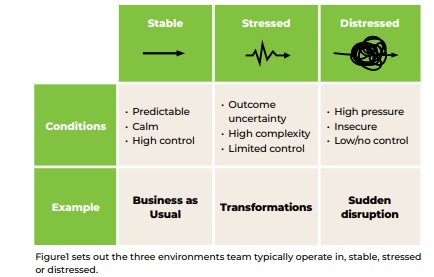
In stable or business-as-usual environments, leaders and teams have high predictability, expectations are clear, roles are well-defined objectives are agreed upon Within a stable environment team harmony is key to working effectively. Effective leaders in stable environments are seeking to motivate their teams, giving autonomy, developing connectedness within the team, and helping individuals seek growth opportunities.
It is worth noting that for many people, the author included, a stable environment is a distant memory of a time before COVID-19 when offices were, people traveled for work, and the level of disruption faced and still being faced was unimaginable.
Distressed environments are caused by a disruption to business, either through a shock caused by external factors such as market crashes, environmental catcatastrophess other unprecedented event such as COVID-19. Teams in distress have little or no control beyond responding to the immediate problems under intense pressure. The role of leaders in distressed environments is command-and-control, being a clear a visible authority as the team navigates the storm.
Distressed environments can also occur when ongoing stress tips over into distress. Transformation processes are by their nature long and arduous, some of the key risks highlighted above can create distress poor leadership and communication, low autonomy, and nd job insecurity when managed badly.
Distressed environments can also occur when ongoing stress tips over into distress. Transformation processes are by their nature long and arduous, some of the key risks highlighted above can create distress poor leadership and communication, low autonomy, and job insecurity when managed badly.
The stressed environment may feel the most familiar to everybody just now. In stress, teams are operating in high complexity, roles, and responsibilities may be ambiguous, and outcomes unclear. Due to the external forces driving transformation, leaders and teams can feel less in control of some of the factors determining decisions. The role of the leader here is to create psychological safety, both to manage effectively in the environment but also to lessen the likelihood of stress becoming distressed.
Leading with psychological safety in stressed environments.
As The Future of Transformation Human research identified, psychological safety is one of six conditions of human behavior key to increasing a transformation’s success nearly three-fold. The others are:
• purposeful vision
• adaptive leadership
• making it real with technology
• disciplined freedom
• and collaboration.
In her book The Fearless Organization, Professor Amy Edmonson defines psychological safety as the ability of any individual to speak up without fear of negative consequences Asserting that in a knowledge economy, the value of our people is what is in their heads, the capacity to problem-solve, collaborate, inno, vote, and create. This is impossible if any individual feels their contribution would be negatively received or ignored.

Psychological safety fosters curiosity and an environment where individuals feel more able to take risks, and where people are more likely to embrace change. In teams with high psychological safety learning from failure is more common and individuals are more likely to ask their colleagues for help. Psychological safety has also been shown to have an impact on employee retention.
For leaders, creating psychological safety means being able to model vulnerability and harnessing the power of ‘I don’t know’. Rather than creating more uncertainty, sharing vulnerability builds connection and trust with others. Leaders also need to invite participation, giving people opportunities to contribute and demonstrating that contributions are being listened to.
For psychological safety, trust is crucial, teams need to know they can trust their leaders and leaders need to know they can trust their teams and peers. In stressful environments, trust is more important than team harmony. This is two-fold, firstly we need to be clear not to confuse likeability with trust. We can all think of colleagues we would rely on to tackle complex problems at work, but we do not necessarily regard them as friends. This is a colleague we trust.
Secondly, leaders and their teams must be capable of engaging in constructive conflict. That is, able to discuss the big and difficult issues respectfully whilst maintaining interpersonal trust. In stressed environments, prioritizing harmony leads to avoidance of difficult conversations, delaying decision-making, and erosion of interpersonal trust.
Intentionally investing in the well-being and mental health of people at all levels is critical to success.
Three key tips for building psychological safety
• Provide a variety of channels and methods for feedback. Speaking up is often overweighted in terms of team contribution. It is important to recognize that some people prefer to contribute or feedback in writing, while others need time to consider before inputting, and in our current structures, those happiest to speak up and speak loudly are often given disproportionate credit.
• Psychological safety is not about being comfortable. Environments with high psychological safety will often be challenging, with people looking to learn and grow and able to have robust conversations.
• Building trust is fundamental. Creating a culture code where all members of the team understand what is expected of them, their behaviors and their responsibilities to others is a great way to establish a baseline of trust within a team.
In stressed environments, leaders who proactively build psychological safety are more likely to hear when things are at risk of tipping into distress, be able to engage their teams around short periods of intense delivery and or stress, and understand how to manage people through prolonged difficult processes.
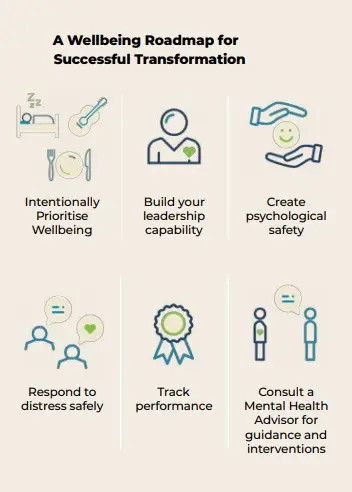
Based on the research outlining the human factors required for a successful transformation, the knowledge that well-being is a pre-condition for the high cognitive performance required for transformation, the understanding of the importance of psychological safety, and our experience in developing effective systems to mitigate and manage distress within organizations, the Wellbeing Outfit have developed a Wellbeing Roadmap for a Successful transformation (see figure 1).
The roadmap has been designed to prepare, sustain, and support people through transformation.
Intentionallprioritizese wellbeing.
Any transformation process requires people to be optimized to perform at their best and in the knowledge economy, performing at our best means being cognitively fit. We need to help individuals understand and track what drives their well-being by eating well, exercising, and engage non-work activities to maintain balance and destress which helps both high performance and avoid burnout.
Tools such as:
• wearable devices
• personalised wellbeing plans
• team Wellbeing Check-ins (sharing wellbeing priorities and being accountable to others)
can all help emphasize the importance of well-being and help individuals trioritize their well-being?
Building Leadership Capacity
Do leaders have the skills and capability required for the change to come? For leaders to be effective they need to have confidence in their leadership style while being adaptable to the environment around them. Leaders need to create clarity for teams with agreed roles, expectations, and behaviors.
As the second phase of the EY research has shown, leaders’ interventions at crucial moments can make or break transformations. Key to these interventions are leaders listening, sense-making (understanding what is going on and how it is impacting people ), and taking action. These three steps at key moments increase the likelihood of a significantly improved transformation performance by 12 times.
Leaders also need to stay the course; anecdotal evidence repeatedly highlights leaders leaning out as change processes drag on. Many leaders are central to the decision-making and further into the change curve than their team. To be effective, leaders need to lean into their teams throughout the change process, maintaining communication and connection.

Building psychological safety.
As outlined above, building psychological safety is key for leaders and their teams. Modeling vulnerability, prioritizing trust over team harmony, and even practicing constructive conflict within the team will help to build psychological safety. To practice constructive conflict, leaders can nominate roles to members of the team to ensure critical thinking, divergent views, and opposition to the prevailing views are heard.
Respond Safely to Distress
Recognising these processes are inherently stressful and at points will be distressing to teams and individuals is vital. Organizations can mitigate against the risks and be better prepared to respond safely when distress inevitably occurs.
This means ensuring a large cohort of people across the organization feel confident in spotting the signs of distress in others and understanding how to act. For example, training people to have supportive conversations and then signpost colleagues to help and support.
The organization must have tools and anandrtnershipss which can provide support appropriate to the situation. Responding to distress safely will help in the long term, minimizing both the impact on the individual and the wider impact on the team.
Track Performance
Tracking performance is about creating measurements to provide indicators that can help leaders throughout the process, managing the known and unknown. From team resilience measurements and elaboration scores, to pulse surveys; these data points provide opportunities for teams to feed in, and for leaders to step out of the weeds of the process.
Continuous measurement will also help leaders assess the effectiveness of any interventions following turning points or pivotal moments where they have needed to intervene to keep the process on track.
Wellbeing/Mental Health Advisors
Having advisors and partners to work with who can help retain and manage the human factors in transformation is vital. Every business wants to move through transformation, retaining the best of their people and attracting new talent. Change management and transformation processes leave organizations radically different but often wrung out, and exhausted, with people slipping away, looking for other jobs, and leaving because the process has been brutal, even if the outcome is what is required.
Intentionally investing in the well-being and mental health of people at all levels of leadership, those in the transformation team, and everyone else in the organization whether they are staying or going in the long term is critical to success.
Conclusion
Transformation is an inescapable reality for most organizations today. It‘s a process full of inherent psychosocial risks that can significantly impact the well-being and performance of individuals at all levels. However, by intentionally prioritizing the mental health and well-being of employees from leadership to frontline workers organizations can not only mitigate these risks but also enhance their chances of a successful transformation. By placing humans at the center of the transformation process, organizations can navigate change more effectively, retain their best talent, and emerge stronger on the other side. Remember, successful transformation isn‘t just about achieving business objectives it‘s about doing so while preserving the health, well-being, and engagement of the people who make it all possible. In this era of constant change, creating psychologically safe workplaces isn‘t just a nice-to-have it‘s a critical factor in determining whether an organization will thrive or merely survive.