





Purchase this article as a standalone PDF with full colour magazine layout
It has been known for a long time that pessimism and negative energy are two of the biggest constraints on the global economy. When people don’t feel positive about the future, they hold back on important decisions that would be difficult and costly. When the light at the end of the tunnel seems too dim or the tunnel seems never-ending, people are less willing to put up with short-term pain.
This is a major drag on growth at both the global and national levels, and leaders must consider how this translates into their organization and understand the energy driving it. Because if you are not paying attention to what fuels your organization, you are flying blind.
If you are not paying attention to what fuels your organization, you are flying blind.
As we move into 2026, leaders are grappling with a vast number of challenges. The aftershocks of global disruptions, the continued rise of hybrid and remote work, and the mounting pressure to deliver better results with leaner teams, to name just a few. But it is not just leaders. Employees throughout the organization are feeling the knock-on effects of these challenges. They may be questioning their job security, struggling with changing organizational demands, confused with shifts in their managers’ leadership style, or finding it hard to compete with other functions for resources.
Amidst these challenges, understanding and measuring how your organizational energy may be delivering or destroying value has never been more relevant. But it is not a concept that many leaders have ever considered. Yet, when given some thought, leaders start to see the link between culture and organizational performance extremely clearly. They see that not only is it incredibly practical, but it is manageable, too.
Think of your organization as a landscape dotted with reservoirs. Some are full and flowing, nourishing the teams and systems around them. Others are stagnant, leaking, or even dammed up by invisible barriers. These reservoirs represent the potential energy within your people, teams, and organizational systems.
Organizational energy is the total amount of ‘horsepower’ that is available through your people, at any given time, to get work done and to deliver performance. Flowing through every level of the business, it is multi-dimensional.
To measure and manage it effectively, leaders must understand its three core dimensions: Employees, Teams, and Systems.
1. Employees: the individual reservoirs
Every employee brings a unique mix of mental, emotional, and physical energy to work each day. Mental energy fuels focus and creativity; emotional energy drives engagement and resilience; physical energy underpins stamina and wellbeing. When these reservoirs are full, individuals are more likely to perform at their best. But when they are depleted by factors such as stress, confusion, excessive competition, bureaucracy, lack of recognition, or poor work-life balance, performance suffers.
High-performing teams are characterized by psychological safety, open communication, and a sense of belonging.
Leaders can support individual energy by finding out, at an individual level, two things:
By answering these questions, leaders have a starting point for eliminating organizational barriers and bolstering the person’s energy, for example, by promoting healthy routines, recognizing achievements, and providing growth opportunities.
Simple practices can make a significant difference, but only when leaders have understood the cause and what works for the individual concerned.
When leaders demonstrate this individual-focused approach, they inspire lower-level management across an organization to shape and influence individual energy. Although this expectation may be unspoken, it becomes an agreed collective responsibility, instead of employees passively expecting solutions to lie with senior management.
2. Teams: the collective charge
Energy also flows at the team level, shaped by the quality of relationships, trust, and shared purpose. High-performing teams are characterized by psychological safety, open communication, and a sense of belonging. They develop strong practices and habits that recharge team energy and reinforce alignment.
Conversely, unresolved conflict, unclear roles, or a lack of autonomy all drain team energy, leading to a loss of productivity. Leaders should regularly assess team dynamics and intervene early to address issues.
At Culture Impact, we use the Performance Triad, which offers a practical lens to explore and address the balance of ‘I’, We’, and ‘It’ dynamics within teams and in decision-making. ‘I’ represents personal perspective and individual responsibility; ‘We’ encompasses the collective relationships, accountability, trust, and shared values within a team; and ‘It’ refers to the structural systems, processes, and goals that guide group actions. Effective teams balance these three dimensions, ensuring that personal motivation, group cohesion, and tangible organizational structures and outcomes align.
If cultural entropy is high, what behaviours, stories, symbols, or systems are reinforcing negative patterns?
This approach complements Frances Frei’s model of trust, which balances three drivers: Logic, Authenticity, and Empathy.
This kind of thinking can help leaders diagnose where energy is flowing or blocked within their teams, whether it is a failure in systems and processes, a deficit in trust, or a need for greater personal authenticity and responsibility. This combined perspective helps leaders shape environments where both individual and collective energy can thrive, driving sustainable high performance.
3. Systems: the organizational flow
Finally, energy is embedded in the organization’s systems (its processes, governance structures, and cultural norms). Efficient systems amplify energy, enabling people and teams to focus on what matters. Inefficient or misaligned systems, on the other hand, create friction, waste, and frustration.
Leaders must examine whether their systems support or hinder energy flow. Are decision-making processes clear? Do policies encourage collaboration or reinforce silos? Is their culture one of trust and empowerment, or control and compliance? By addressing systemic barriers, leaders can unlock reservoirs of untapped energy.
When all three of these reservoirs are healthy and connected, energy flows seamlessly toward productive work. This in itself becomes a powerful competitive advantage. But when blocked or depleted, performance suffers, even if employees are working at full pace.
For example, a reservoir of trust might be overflowing in one department, fuelling collaboration and innovation, while another team’s reservoir of clarity is running dry, leading to confusion and frustration. By mapping these reservoirs, leaders gain a powerful visual and strategic tool for diagnosing and addressing the root causes of performance challenges.
Regularly measuring energy and paying attention to the subtle symptoms, such as levels of enthusiasm, engagement in meetings, or feedback on systems, enables leaders to respond proactively rather than reactively. By embedding energy awareness into everyday practices, organizations become more resilient, adaptable, and more successful in driving sustainable high performance, despite the complexity of today’s workplace.
Organizational energy is what your employees feel, but that does not mean it is not tangible. Tools exist that help you measure and track energy in simple but effective ways. Take Barrett’s Cultural Entropy Framework as an example. This reveals a score that assesses the energy wasted in an organization due to unproductive or unnecessary work, concerns, and frustrations. It shows where and how much energy leaks from your system unnecessarily. Frameworks like The Energy Project’s Four Energy Dimensions offer different lenses for assessing where energy is being generated or drained. These help leaders turn ‘gut feelings’ about their workplace culture into evidence-backed insight that measures their current culture.
Our work with clients takes this a step further. The goal is not just to get a number, but to use these insights to guide meaningful change. Measuring energy helps leaders see where their organization is thriving and where it is leaking vitality, and with this information, leaders can start to map the change needed to ensure the organizational energy aligns with their strategic aims.
Without visibility, energy leaks go unnoticed. Leaders often respond by pushing harder and demanding more output, without realising they are burning through finite reserves.
But by having this level of clarity, leaders can identify and dismantle misaligned systems that block or drain energy and look to strategies that use untapped sources of energy sitting within the organization.
To put this into context, recent research, including our ‘State of Culture Strategy Alignment Report 2025’, highlights employee burnout as one of the most serious organizational energy issues, at both a performance and human level. Concerned leaders often rush to fix the issue. It is typical to see wellbeing initiatives introduced, the rollout of tools to help resilience, and innovative approaches to developing managers’ soft skills. But these do not get to the root of the issue. Employees have a finite amount of energy, and when this is eroded by the day-to-day reinforcement or toleration of certain patterns of behaviour, symbols or systems that drain energy, no amount of resilience training, fruit bowls or mental health days will touch the sides.
The problem is that most attempts to improve these kinds of scenarios are aimed at resolving symptoms, not the cause. To resolve burnout or any other such issue, leaders must examine the patterns of behaviour, symbols, and systems that deplete employees’ energy. It is only at this level that leaders can truly address what they are facing.
It is a common misconception that high energy is always good, and low energy is always bad. In reality, both can be productive or destructive, depending on context.
Destructive high energy can manifest as chaos, aggression, or relentless busyness, leaving teams working at a frantic pace but achieving little value. As the saying goes, there is a significant difference between movement and progress. On the other hand, sometimes, a calm, low-energy environment is exactly what is needed - think of a team in deep concentration, taking regular time to reflect, or a leader providing steady guidance during uncertainty.
It is all about balance. The best organizations have a mixture of low and high energy flowing throughout their teams. No business will be the same. Leaders must learn to read the energy in their organization and distinguish between productive and unproductive forms. This requires observation, honest feedback, and a willingness to challenge assumptions. Sustainable energy management means balancing drive with recovery, ambition with wellbeing, and performance with meaning. Leaders need to be aware when too much energy is being taken from specific “tanks” (mental, emotional, physical) and take steps to replenish them.
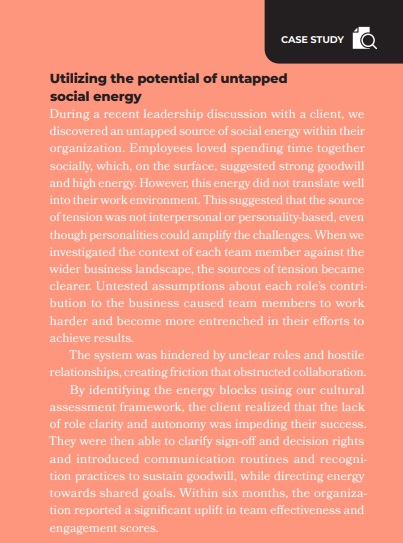
If energy is pooling in one department but absent in another, what systemic barriers are preventing flow? If cultural entropy is high, what behaviours, stories, symbols, or systems are reinforcing negative patterns? If energy is misaligned with strategy, how can leaders recalibrate priorities and communication?
The goal is not to chase “high energy” everywhere. It is to ensure the right energy flows to the right places for the right purpose. Organizations that can ‘catch themselves early’ and rebalance the appropriate energy for their individual circumstances have an advantage. By doing so, they demonstrate the courage to slow down to accelerate progress, ensuring that the quality of effort, energy, and output align.
Looking ahead, the ability to measure and manage organizational energy will become a defining capability for high-performing organizations. Organizational energy is what turns strategy into action and potential into performance. Leaders must go beyond measuring organizational energy and take the extra steps to actively manage it to unlock new levels of engagement, resilience, and success.
As the world continues to demand leaner organizations and higher levels of performance, understanding and optimising your organizational energy must be a priority for 2026. Imagine an organization where energy flows freely. Your employees are engaged and aligned, and your systems support rather than hinder progress. This is a completely achievable reality for leaders willing to make energy management a strategic priority.
The journey starts with asking: Where are our current pools of energy, are they effective, and how can we make them flow better?