




Purchase this article as a standalone PDF with full colour magazine layout
In July 2025, Scottie Scheffler was in the news, just before the British Open golf tournament at Royal Portrush, which he went on to win ‘at a canter’.
Speaking ahead of the final major of the 2025 season, the talented world no.1 golfer, who has dominated the sport in the last few seasons, shared some very candid thoughts and feelings about life and about winning in particular:
“I think I said something after the Byron [Nelson golf tournament] this year about how ‘it feels like you work your whole life to celebrate winning a tournament for like a few minutes’. It only lasts a few minutes, that kind of euphoric feeling. To win the Byron Nelson Championship at home, I literally worked my entire life to become good at golf; to have an opportunity to win that tournament. You win it, you celebrate, get to hug my family, my sister’s there, it’s such an amazing moment. Then it’s like, OK, what are we going to eat for dinner? Life goes on.
“Is it great to be able to win tournaments and to accomplish the things I have in the game of golf? Yeah, it brings tears to my eyes just to think about it because I’ve literally worked my entire life to be good at this sport. To have that kind of sense of accomplishment, I think, is a pretty cool feeling. To live out your dreams is very special.
“But at the end of the day, I’m not out here to inspire the next generation of golfers. I’m not out here to inspire someone to be the best player in the world because what’s the point? This is not a fulfilling life. It’s fulfilling from the sense of accomplishment, but it’s not fulfilling from a sense of the deepest places of your heart.
“There are a lot of people who make it to what they thought was going to fulfil them in life, and you get there, you get to No. 1 in the world, and they’re like, what’s the point? I really do believe that, because ‘what is the point?’ ‘Why do I want to win this tournament so bad?’
“I don’t know if I’m making any sense or not. Am I not? It’s just one of those deals. I love the challenge. I love being able to play this game for a living. It’s one of the greatest joys of my life, but does it fill the deepest wants and desires of my heart? Absolutely not.”
Humans, individually and collectively, need to reinvent themselves to survive and thrive, to evolve, and Game Changers were the catalyst for this change.
On a very different stage, Alison Balsom, the multi-award-winning British trumpeter, recently announced her retirement. Her performance as the soloist at the Last Night of the Proms was to be her last professional performance. The Royal Albert Hall, with an audience of nearly 6,000 people, had some 3.5 million viewers watching the live broadcast at home.
Making her announcement, she said:
"I feel less need to prove myself to the world, and more of a pull to grow broadly as a creative person away from external validation.’
"This Prom, which, if I could pull it off, felt like the ultimate mic-drop.
"In 2009, I was fighting so hard to prove to the world that I was good enough. Whereas now I don’t really care what the world thinks; I know I’ve got something to say, and a wonderful piece of music to give to the audience. I feel that much more honestly now than I did before."
To the detached observer, we might consider Scottie and Alison to have reached, in the terms of Abraham Maslow's ideas, a state of self-actualization (1943); the very pinnacle of what has become known as ‘Maslow’s Hierarchy’ of human motivation.
But Scottie and Alison’s stories suggest that people who strive for those states of being do not lose the drive once they get there; the drive does not suddenly go away; that self-actualization is not a static state of being.
How can we understand this aspect of human nature and what its relevance is for leadership?
In broad terms, we know that human beings are ‘hard-wired’ to have an impact upon their world, to learn to adapt and survive; human beings compete with each other and with their environment.
People differ in terms of the energy they focus on ideas, actions or relationships.
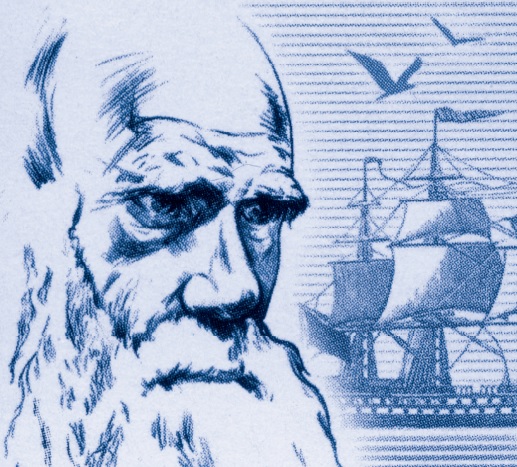
As Darwin put it:
“It is not the strongest of the species that survives, nor the most intelligent, but the one most responsive to change.”
With human beings, this drive for mastery continues, and many will delight in seeing the extent to which the complex action of walking becomes a Florence Griffith Joyner or a Usain Bolt, setting world records for running fast and then wanting to run even faster.
Their actions, ultimately, give us collective hope in the ability of the human species to survive and thrive. Thriving, excelling, is a demonstration of the human potential to survive through developing our capabilities, learning from, and adapting to a changing world.
The paradox, of course, is that this human drive for mastery may come to destroy the human species: we can become complacent in our belief in our collective ability to master our world with science and technology, and we are witnessing this with our global management of a climate crisis rapidly reaching a point of no return but with a view that someone will come up with the ‘magic answer’.
While the drive to survive and thrive may be ‘hardwired’, we also know that how people channel their energy for impact, for surviving and thriving, is not uniformly the same; there are well-understood individual differences.
The hope was that there would be game-changing leaders who could revitalize stagnant sectors of our economy.
We see these differences in Scottie and Alison’s stories. Scottie is searching for purpose and meaning in life that golf has not quite satisfied. Moreover, that purpose comes, for him it would seem, from close and intimate relationships, family. That sort of connection might be hard to achieve in a competitive solo sport.
For Alison, we see a drive for perfection underpinned by a need to ‘prove herself’ and to be creative. The drive to prove herself has been satisfied, but the need for creative expression is still there.
It would seem then that people have a need to reinvent themselves at key points in their lives; they want to see what is possible; to test themselves perhaps, in different ways. It can seem a paradox at times that we can all be ‘creatures of habit’, but our world demands that we adapt if we are to survive.
Alison and Scottie’s stories are consistent with our understanding of the different ways in which people seek to channel their energy to have an impact on the world. Broadly speaking, people differ in terms of the energy they focus on ideas, actions or relationships. So, for some, the expression of energy is upon the mastery of a craft, for others it is about shaping ideas and possibilities and creating change, and for others it is about connecting and mobilizing people.
The challenge of human behaviour is not simply about the existence of drive, but about how that drive is expressed and harnessed for making a meaningful contribution.
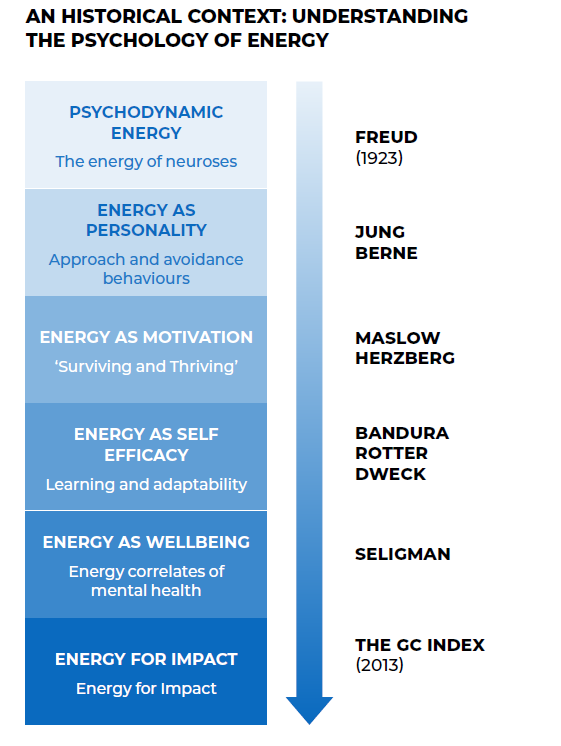
Psychologists have, for over a hundred years, been fascinated by how humans channel their energy, starting most notably with Sigmund Freud in 1923, who offered us a model of the energy of the psyche: Id, Ego and Superego. Often criticized for being beyond the scope of scientific verification, his model was hugely influential.
This influence upon the study of human energy is captured, in broad outline, in the diagram above.
The GC Index focuses on Energy for Impact, which emerged from research begun in 2013, triggered by the need for organizations to reinvent themselves following the global financial crisis of 2008.
The research supported the view that there were individuals, tagged as ‘Game Changers’, who could bring energy to transforming organizations, to help organizations reinvent themselves. These individuals were characterized by their capacity to generate original ideas and to focus upon them obsessively; think Einstein in the world of science, Banksy in the world of art or Musk in the world of business.
This learning felt quite consistent with a Darwinian view of human adaptation; that humans, individually and collectively, need to reinvent themselves in order to survive and thrive, to evolve, and that Game Changers were the catalyst for this change.
There were also echoes in these observations of the views of leadership offered to us many years ago by James McGregor Burns (1978).
Burns talked about Transactional Leadership in which leaders deliver short-term outcomes with a focus upon managing practical processes and outcomes and people problems along the way. Given his picture, these leaders would be more suited to organizational worlds with a focus upon survival and within which employees turn up and take the paycheck at the end of the week, where work is transactional.
We know that this world of work still exists, but over the last 150 years, many millions of people have also had a growing number of options about work and are looking for a different sort of meaning and purpose beyond just ‘paying the bills’. Work can now be transformational in people's lives. This, for Burns, needed Transformational Leadership.
Our survival and our flourishing depend on the same restless energy that both unsettles and propels us forward.
Game-Changing Leaders, like Transformational Leaders, at their best, lead with inspirational possibilities rather than feel constrained by ‘what is’; they bring energy and possibilities to ‘what might be’. They bring hope to our picture of the future and, in doing so, contain the anxiety that comes with uncertainty.
This is where leadership and creativity converge. By definition, leaders see into the future. Some will see the future as an extension of the past, some, Game Changers, will bring creative ideas and transformational possibilities. In doing so, they will tap into individual needs for collective purpose, growth and creativity, the drivers that emerge from Alison and Scottie’s stories.
As leaders and organizations begin to understand not just what people can do, but also where their natural energy to make a contribution and impact lies, they gain new ways to unlock that purpose, creativity and growth.
This understanding of individual differences creates the potential for greater alignment between an individual’s drive and organizational direction, a recognition that the challenge of human behaviour is not simply about the existence of drive, but about how that drive is expressed and harnessed for making a meaningful contribution. This, if you like, is a more sophisticated take on ‘round pegs in round holes!’
We cannot outgrow it. The real question for leaders, organizations, and society at large is not whether people are motivated, but how their innate energy for impact is being channelled. When it is ignored or misdirected by individuals, it can lead to frustration, a loss of confidence, burnout and depression.
When not harnessed by organizations, it can lead to stagnation and fragmentation. But when it is recognized, valued, and aligned, it becomes the most powerful force for transformation we have.
When leaders create the conditions for people to take the lead, contribute their best, and align their energy for impact, teams move beyond hierarchy and personality to become truly dynamic.
What does this mean for Scottie Scheffler? Does his discontent reflect that he is not channelling his energy into the right activity, golf? Does he need to reinvent himself now that he has mastered the skills of golf? For Alison, ‘watch this space’ with her stated intent to carry on expressing her creativity.
Perhaps the challenge for our times is to shift our focus away from asking if people want to make an impact, and instead understand where and how they most naturally seek to make it. Only then can we truly begin to understand the paradox of human behaviour that our survival and our flourishing depend on the same restless energy that both unsettles and propels us forward.
This understanding of human Energy for Impact also has clear implications for how leadership functions in teams when harnessing its collective energy for impact.
The traditional view that teams are ‘led’ by the most senior individual is well overdue for review.
The traditional view that teams are ‘led’ by the most senior individual is well overdue for review. It is a static, hierarchical view of leadership that associates leadership with hierarchical success: leadership is about having the ‘pips on your shoulder’.
This view is reflected in the paradigm-shifting work of researchers like Warren Bennis and Burt Nanus (1985), who developed our understanding of leadership and, specifically, what leaders actually do, with an emphasis upon observation: building a model of leadership rather than seeking to prove a theory. This approach seeks to understand the world as it actually is, rather than seeking to impose conceptual models upon it.
However, the limitation of this approach is captured by the saying: ‘He is gentil that doth gentil deeds’, Chaucer (1387). More specifically, if people in a formal position of leadership, CEOs in the Bennis and Nanus study, become the definition of leadership, then our understanding of leadership is determined by and limited to hierarchical status.
In recent years, the world of sport has introduced us to the idea and practice of what we would call Dynamic Leadership in teams. Women’s and men’s rugby and cricket now increasingly operates on the basis if of multiple leaders with different team members taking a lead at different times, dependent upon the needs of the situation. The difference here is between ‘being the leader’ and ‘taking a lead’.
We have also seen this approach in Scottie Scheffler’s world of golf. Take the example of the Solheim and Ryder Cup teams. These teams have the formal roles of Captain and Vice-Captain, but players are also encouraged to ‘take a lead’ in the moment, and it is this that can underpin a team’s success.
This theme is explored in more detail in this article: ‘Taking the Lead’ by Dr John Mervyn-Smith
We have seen the power of this approach many times in leadership teams. One notable example involved the executive team of an online bank. The team sees itself as dysfunctional, with a longstanding member saying that it was: ‘dominated by too many men with opinions who couldn’t agree, so nothing gets done in a collective sense.’
To an extentt she was right. Many of the team, in GC Index terms, brought energy to, and were comfortable with, abstract concepts, theories and exciting possibilities; the Strategists and The Game Changers in the team, including the team’s leader. These were people who trusted their judgment and failed to align with an agreed view and had less energy for testing the operational feasibility of their ideas. The team made great strides when they realized that the Implementers in the team needed to shift the debate from ideas to action; they needed to ‘step into’ that leadership role. Moreover, the Polishers needed to bring data and evidence to the debates that could lead to quality decision-making.

This clarity of leadership role and contribution gave people permission and authority to make the contribution and impact that the team so badly needed. Historically, much of the focus on developing teams is to try to get to this point through building awareness of self and others through the lens of personality. This Dynamic Leadership approach shifts the focus to impact and contribution.
For leaders who want to embrace this dynamic approach to team leadership, they need to:
The challenge for leaders is not to generate energy, but to channel it. Every team already has within it the restless drive to survive, adapt and excel. The real question is whether that energy is ignored, misdirected or harnessed. When leaders create the conditions for people to take the lead, contribute their best, and align their energy for impact, teams move beyond hierarchy and personality to become truly dynamic.


