





Purchase this article as a standalone PDF with full colour magazine layout
On a glorious early summer’s day, some years before he died, my father, a man of nature, brought me to his favourite place and invited me to look upwards towards the vast blueness and listen carefully. My eyes squinted hard to no avail, but within seconds I heard it, a high, thin, melodious sound of the soaring lark, a birdsong which struck right into my heart. I often think of that day, a legacy of sound and beauty which went beyond any conversation or meaning-making. For me, it imparted the power of sitting in stillness and listening to what unfolds, a wisdom of sorts.
Many years later, as I ambitiously sit at my desk to write an article on leadership wisdom, a deep sense of irony emerges as I fight a busy mind, full of duties and accompanying thought processes; caregiver roles of my children and an elderly parent, demands of my work, administration, keeping fit and sane, all while preserving my own identity during competing roles. As faculty at an international business school, I find that most of the professionals/participants who sit before me are similarly fighting a sea of noise and struggles in their own exhausted brains. Without sounding too nostalgic, and with the birdsong still in my ears, it appears that in the past, most of us had much more time to think and feel. Picture a time where you sat with a favourite elder and witnessed the slow, thoughtful process of how they spoke and thought about situations, as if searching through the mist on how to respond. The response may have been abstract and loaded and could be interpreted in a myriad of different ways, perhaps what we might now describe as wisdom. Nowadays, we are flooded with immediate responses to questions by the less wise (funny how they always answer first), which are often meaningless and rarely advance us in any meaningful way. Action is proposed as productivity and knowledge, when deep down we know the very opposite to be true. Perhaps I can now invite you to find your inner wisdom to meet and shape your context differently.
“Organizations simply cannot be led top-down, for an ecosystem requires nurturing, not controlling”
It is an impossible task to quantify wisdom, which is highly subjective and difficult to define. However, we do know where wisdom resides in our brains. The prefrontal cortex figures prominently in several wisdom subcomponents (eg, emotional regulation, decision making, value relativism), primarily via top-down regulation of the limbic and striatal regions. The lateral prefrontal cortex facilitates calculated, reason-based decision-making, whereas the medial prefrontal cortex is implicated in emotional valence (whether it creates a positive or negative mood reaction) and prosocial attitudes and behaviours. McGilchrist (20251) describes how classic Greek writings on wisdom focused on rationality, whereas the early Indian and Chinese thinkers stressed wisdom as finding emotional balance. Irrespective of chronology, these conceptualizations of wisdom share several common features, such as thoughtful decision making, compassion, altruism, and insight. The purpose of eliciting wisdom is to differentiate it from knowledge versus knowing, and how this is often what dominates effective leadership behaviours. Wisdom takes many different shapes. Our mind is a collection of mental processes such as thinking, feeling (emotions) and consciousness; while sitting alongside this is our cognition, which is the act of perceiving, learning and remembering, and can be described as ‘an interwoven set of psychological and observable characteristics which engages the filtering process and gives rise to construed reality and strategic choices’ [Finkelstein and Hambrick (1996:45)].
The brain created two hemispheres to ensure we pay two kinds of attention; the left side, which is narrow, focused and inanimate, while the right side is uncommitted, broad, and vigilant.
In the universal backdrop of our internal neurological workings, the world burns, ecologically and metaphorically. The natural and social world is suffering in an unimaginable way. The planet is heating while we, as capitalists, produce more and more of what the world wants but does not need. Online media beams paradoxical horrors: starving children with gaunt faces chillingly positioned alongside botox-filled celebrities touting their latest lip-enhancing product. We watch in hope as impeccably suited first-world governments meet to discuss the latest war-torn famine while simultaneously having their GDP funded by providing military weapons, which bomb the latest whims of the newest dictator. As a social scientist, it is a bewildering time to be alive and grapple with human behaviour.

The moral compass which guided us appears to be broken, while loud opinion looms large and knowledge and experience are cast aside as dull and insignificant. As we work within top-down structures, the research suggests we are struggling as leaders to influence, create engagement and innovate to make a real difference. The 2025 Gallup Survey2 indicates that global employee engagement declined to 21% in 2024, with managers experiencing the largest drop, while employee well-being has been declining since its peak at 35% in 2022. This may well be related to the architecture of our organizational structures, a throwback from Industrial Revolution times, where humans were placed in a building to work from morning until evening to achieve outputs for a small few shareholders (Laloux, 20143). Have you been forced to return to the office yet?!
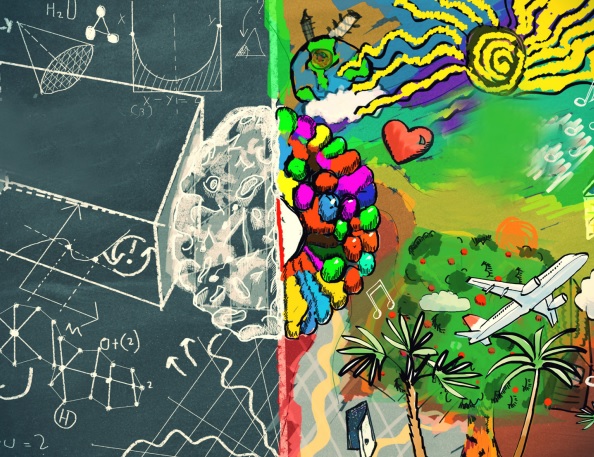
As social scientists, we remain curious as to why organizations persist with mechanistic designs with a single leader in charge. Western4 agrees, suggesting that “organizations simply cannot be led top-down, for an ecosystem requires nurturing, not controlling. We suggest that with a small and subtle adjustment of our neurobiology, we, as leaders, can begin to evoke wisdom and get in touch with and create a more palatable reality for ourselves and create more meaningful and fulfilling organizations, taking into consideration the ecological and societal context.
The left brain suggests we are just apes who compete for money, territory and power so we can grab and manipulate to achieve such ends.
McGilchrist boldly suggests that the human brain has been hijacked. As a psychiatrist, philosopher and neuroscientist, his work focuses on the brain as an asymmetrical organ divided into two hemispheres,s going back hundreds of millions of years. The human brain evolved to navigate a Darwinian problem of survival, which, in simple terms, is that paying only narrow attention to something will not allow you to survive. He describes the bird’s narrow focus on just catching the worm (left hemisphere) could end up in it being eaten. Therefore, the brain created two hemispheres to ensure it pays two kinds of attention: the left side, which is narrow, focused and inanimate, while the right side is uncommitted, broad, and vigilant. The left side is explicit and takes in bits of information but can offer no meaning and is devoid of emotion or spiritual context, embodied experiences or physical context. The right hemisphere is implicit and sees that everything is ultimately connected and places each input it receives in the context of meaning. It can be seen that humans are embodied, understand bodily gestures, puns, along with emotions and the hidden inner life of humans. Placing our neurobiology (more crudely) in a contemporary setting, the left hemisphere suggests we are just apes who compete for money, territory and power so we can grab and manipulate to achieve such ends, while the spiritual, truth, goodness and honesty capabilities of humans are marginalized and trivialized. In effect, consciousness and spirituality are deemed a secondary relation to power.
In contrast, the right hemisphere can farm out procedural work to the left hemisphere as it is meant to be an adjunct to the right hemisphere, acting like a personal computer (PC) or Artificial intelligence (AI). Far from the algorithmic binary computational systems which are AI, the right hemisphere uses multiple inputs to decipher what we can trust and is most in touch with reality. However, we know that the left brain, if left unchecked, can span the Dunning-Kruger effect, which is a cognitive bias where people with limited competence in a particular domain overestimate their abilities. As McGilchrist offers, true wisdom is when one is less certain than one knows, and it is rare.
Real wisdom involves gathering life experiences, having a sense of the spiritual and the ability to aggregate information. The contemporary context of knowledge involves information triumphing over understanding, and as we know, understanding is where real wisdom sits. The sense that we think we know (limited) things and can solve everything has made us hubristic and vain, but as humans, we do not always understand things widely. To achieve true fulfilment, most humans know how to sacrifice for one another and enjoy social relationships and belonging as well as competition.
Perhaps the role of AI is to do the work of the left hemisphere while we finally offer time and space to the right hemisphere.
The connecting bridge between the two hemispheres is called the corpus callosum, and although it has not changed massively over millennia, we use it differently depending on what is culturally or financially rewarded. It is easy to see the cultures that value the collective over individualistic behaviours. Such cultures focus on nature and family, and strengthening their cultural traditions to preserve the generations to come, so they do not get lost to foreign forces of gain at the expense of others. Some societies and indeed organizations are experiencing a left-brain overreach, where highly complex aspects of human capital and society are oversimplified and bureaucratized. In addition, when we disconnect from nature or spiritual traditions and speak in abstract or theoretical terms regarding politics, economics or healthcare, we offer an oversimplified version of truth.
Some social scientists offer ways to lean closer towards right hemisphere thinking, but examine other aspects of the brain and mind, such as personality. Freud proposed that the mind is divided into three components: id, ego, and superego, and that the interactions and conflicts among the components create personality (Freud et al. 19615). According to Freudian theory, the id is the component of personality that forms the basis of our most primitive impulses. In stark contrast to the id, the superego represents our sense of morality and thoughts.
In contrast to the id, which is about the pleasure principle, the function of the ego is based on the reality principle — the idea that we must delay gratification of our basic motivations until the appropriate time with the appropriate outlet. The ego is the largely conscious controller or decision-maker of personality. The ego serves as the intermediary between the desires of the id and the constraints of society contained in the superego. We may wish to scream, yell, or hit out, and yet our ego normally tells us to wait, reflect, and choose a more appropriate response.
When it comes to finding wisdom, as leaders, we must counterintuitively lay down our ‘need to know, be glorious and be right’. This requires us to both recognize and, if needed, shift away from ego, which is normally associated with our need for self-esteem, self-importance, identity and seeing oneself as distinct and separate from the world with the ability to assert oneself in the world (Hutchi,s: 20146), akin to left hemisphere dominance (McGilchrist, 20127). We should also acknowledge that the human ego is vital and offers very specific capabilities to lead in various situations. It enables us to shape the world according to our own wishes and desires; to satisfy our own needs, however, it is very limiting if we are trapped in unresolved ‘ego needs’ like a need for security, inclusion or recognition. Such insecurities can drive us to assert ourselves at the expense of others or alternatively to isolation and the subsequent disengagement of leaders and employees.
Partnerships for Forests8
Balance is key, and if we exist in a society where one aspect of our minds or neurobiology becomes more dominant, we lose touch with reality.
Perhaps the role of AI is to do the work of the left hemisphere while we finally offer time and space to the right hemisphere, where we, as leaders, conceive organizations as ecosystems rather than closed systems (Olivier et al. 20219). What would it be like for you as a leader to lean back and view your organization as a web of inter-personal connections and networks that operate like eco-systems, an ‘interdependent whole’ rather than a solitary machine? One company that epitomizes right hemisphere thinking, generating an ecosystem of minds, et is Veja (featured in the Case Study above), where entrepreneurship and leadership have focused on the collective first and built a successful business as a result.
It is important to point out that, as humans, we need all aspects of our neurobiology, and we are not advocating one in preference over the other. Balance is key, and if we exist in a society where one aspect of our minds or neurobiology becomes more dominant, we lose touch with reality. McGilchrist goes so far as to suggest that, as humans, we have become stupid and suggests that historians, anthropologists, sociologists and philosophers will look back at this time as the most absurd era where rather negligent and improbable things have been said and executed. He suggests that if we can recognize when the left hemisphere (or id) is in charge, we simply place it back in the role of emissary or servant. This will allow us to see things more broadly and not treat its presentation as the whole story,y but only part of it. As our awareness deepens, we can begin to observe shallowness and sound bites around us and not place them above the higher order of things, where wisdom, human, social and environmental connection is at the forefront.
Perhaps if we begin to move away from conflating knowledge with wisdom and think about fostering the collective, leaders can build emotional capital, psychological safety, and resilience within teams and develop capacities that extend influence far beyond formal organizational boundaries. Finally, in those unhappy times when you are tormented by what you desperately want and not what you need: go still, look upwards and hear what the lark song might be trying to tell you.


