






Purchase this article as a standalone PDF with full colour magazine layout
In Canada, we have a quick-service restaurant named Tim Hortons, which is a national obsession. From its double-double (double cream, double sugar, in a unique proprietary blend of coffee) to its hot weather equivalent, the Iced Capp, to its TimBits, which come in two forms: a party pack box of 12, 24, or 48 multi-flavoured sugary donut holes and a hockey league for 4 to 8-year-olds, equally sweet and delightful.
Tim Horton’s is so iconic and integral to Canadian culture that the Canadian Armed Forces had a pop-up Tim Horton’s in Kandahar, Afghanistan, during the war. Recently, our daughter and son travelled to Singapore, Thailand, and Dubai, and were delighted to discover their beloved Timmys in all three locations. We just visited Glasgow for the first time and saw one right across from Strathclyde University, the host of the 2024 Global Followership Conference.
Their current style of followership could be transformed from a passive, compliance-oriented approach to an active, proactive, initiative-taking style.
We had the pleasure of working with one of Tim Horton’s most successful franchises, the Seth family. At the time, they owned over 50 locations and garnered 2x to 3x higher profitability than average stores. They were the crown jewel of the franchise.
The secret to their success, according to their CEO, Amit, was believing deeply in the potential of each team member and continually investing in their learning and development. When we met him, he had trained all his senior leadership team, store managers, and assistant store managers on Servant Leadership. The year after, he brought us in to teach everyone Followership. Specifically, Amit envisioned his organization could reach higher performance if their current style of followership could be transformed from a passive, compliance-oriented approach to an active, proactive, initiative-taking style, the kind we talk about in our book, Leadership is Half the Story.
With the rise of Thomas Carlyle’s Great Man Theory of Leadership, the importance of following and followership was forgotten.
One day, we were sitting in one of his restaurants, chatting with the store manager and looking out the window waiting for Amit to arrive for a meeting. We saw him drive into the parking lot in his BMW 8-series, get out of the car, and look around. Clearly, he saw something that did not please him at all. Amit, in his immaculate business suit, started picking up litter in the parking lot. When he had a handful, he came over to the store, put it in the trash, and went back out. The store manager followed him out and they both continued cleaning.
We have mused this small incident this leadership-followership moment for years, now. It perfectly illustrates how leading and following can work, and we have thought on how it might work even better.
Imagine, for a moment, that you were the store manager in this situation. Most of the time, within the store, you lead. However, when Amit is around, you step into the role of follower. This is a similar position that most leaders find themselves in: sometimes you lead and sometimes you follow, whether you are a frontline manager or even the CEO, following their Board of Directors.
One thread remained constant: it was all about what the leader did, as if the response by followers was predictable, controllable, and automatic. How people respond to what you do is as important as what you do.
Back to the scenario: imagine you notice your boss picking up the trash in the parking lot. What are all the things you might do? What would your likely response be?
We can imagine four possibilities:
1. You do what the store manager actually did in this case, you go out and help by doing the same thing. You mimic the leader. This might be described as an example of good followership.
2. Perhaps, though, you spot an opportunity for greater efficiency and safety. You bring a couple of pairs of rubber gloves and empty rubbish bags with you, speeding up the process, helping the boss stay clean, and keeping the rubbish outside the restaurant. You complement what the leader does. This is strong followership.
3. How might you go even further? You could do all the above and engage other team members in various ways. For example, you could set up a cleaning schedule for the parking lot so that there will never be a time in the future where the boss shows up and the lot is messy. Or you could bring the topic to the next team meeting and ask team members for all their suggestions for ensuring this never happens again. In other words, you take initiative that fulfils the goals of the boss, even without them having to ask you for it. This is an expert level of followership.
An eliciting behaviour might be telling your leader you need more positive feedback - what you are doing is trying to get them to be more transformational in their approach
4. Of course, there is a fourth option. You could stay in the restaurant, thinking how great it is that your boss is cleaning the parking lot. In fact, the next time the lot needs cleaning, you will invite him over again. That is poor followership because you missed the point.
We have found this response typology mimicry, complementarity, and initiative-taking to be a useful way to think about the following role and the positive impact it can create in partnership with the person leading.
Leadership theories generally suggest that there is only one possible response: if you do A in your leadership role, people will inevitably respond with B. We see our job as picking up after this sort of leadership rubbish because it is not true. In Tim Horton’s scenario above, the success of Amit’s leadership style depended on how his team responded to it. If his team followed in the right ways, he was successful. That was why he brought us in, because Servant Leadership taking on a follower role even when you are the formal leader only works if the people in formal follower roles are willing to lead and know how and when to do so. There is no point serving if no one else takes the lead. There is no point in “leading the way” if team members are unwilling, unclear, or unable to mimic the person leading. In a partnership, both partners need to understand and enact their roles well while also being aware of what the other is doing so they can create a suitable response.
Why Followership?
Thoughtful followership is just as important to outcomes as thoughtful leadership. In a meta-analysis on the value of strong followership on success, organizations with one standard deviation better followership showed an improvement of 17-43% on virtually every significant metric: productivity, quality, service levels, customer satisfaction, engagement scores, top-line results, and even bottom-line profits. Followership matters, yet few HR and Organization Development professionals know about it, few leaders mentor it explicitly with their teams, and even fewer organizations provide training on it. This is a gap; significant organizational value is being left on the table.
75% of senior women’s careers are derailed because of poor followership, more than for any other reason.
Interestingly, ideas of what constitute great followership are as old as ideas about great leadership. The earliest recorded story, The Epic of Gilgamesh, is as much about Gilgamesh learning to lead as it is about Enkidu - his slave and later friend - following courageously and well.
How Did We Get Here: A Brief Look at Leadership Research
It was not until the 19th Century, with the rise of Thomas Carlyle’s Great Man Theory of Leadership, that the importance of following and followership was forgotten. Why is that? What happened to make us forget half the story? The answer lies in the rise of industrialization.
With manufacturing came standardization, where people became akin to the parts of a clock, ticking along and doing the same tasks over-and-over again. The desire to get all the right parts working in exactly the right way led to the creation of an approach during the latter part of the 19th Century known as Scientific Management or Taylorism. The prime architect of this approach - Frederick Taylor - noted that the job of a leader was about “knowing exactly what you want men to do, and then seeing that they do it in the best and cheapest way.” He formalized and provided guidance on the best ways to organize, the best ways to standardize, and the best ways to work by developing and applying ideas such as time-and-motion studies. Henry Ford advanced Taylor’s ideas to create the modern assembly line in the early twentieth century. In this highly leader-centric view of the world, the most important leadership problem was about figuring out who could arrange and train all the parts to perform best. And what better way to answer this than to study the traits of successful leaders?

The agility to show up as a strong leader when needed and then to pivot to a strong follower when someone else is leading is truly the mark of excellence. It is what distinguishes someone who is in service to the mission of the organization rather than to themselves.
Almost the entirety of the first half of the 20th century was spent searching and researching the traits of “Great Men.” Hundreds of possibilities were suggested and evidence was provided for the relative importance of each trait, some as prosaic as the height of an individual, some ridiculous such as the length of an individual’s index finger, and some that seemed quite reasonable such as cognitive ability. Finally, in 1948, R.M. Stodgill published a seminal paper that showed that statistically there were no traits correlated more with leaders than followers. For the next 40 years, from about 1950-1990 (see Figure 1), a variety of other theories were proposed. First came the Task Approach vs. People Focus and other behavioral ideas of what defines great leadership, then came the rise of charismatic theories such as Transformational Leadership as well as a broad array of others including Servant Leadership, Authentic Leadership, Leader-Member Exchange, Ethical Leadership, and more. But one thread remained constant: it was all about what the leader did as if the response by followers was predictable, controllable, and automatic. Anyone who has worked in the day-to-day world of a frontline or middle manager knows this just isn’t so. How people respond to what you do is as important as what you do.
Followership Research
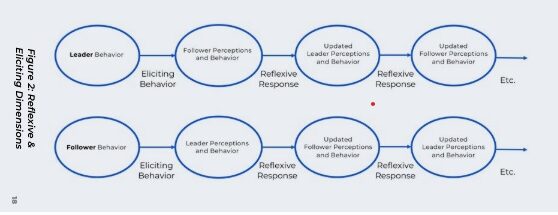
We interviewed 40 senior managers about what they have learned about followership over their long careers. The results were intriguing. Qualitative analysis of the data showed that their success depended on two dimensions (see Figure 2). The first dimension is what we call Reflexive Followership: the ability to reflect on what the leader is trying to do and figure out how to enhance it. For example, if a leader is attempting to be transformational by providing encouragement, it is equally important to “be” encouraged. In other words, actively support the leader’s skills and behaviours in order to further their goals. Think about an interaction you have had with your team members, for example. When you asked them to follow your lead (mimicry), did they? And when there were different possible responses, such as in Tim Horton’s case, did they figure out which was the best option and do that? Do your followers regularly ask you if they applied the best response in a situation? Do you trust that they deeply understand the goals you are trying to achieve before they set out and take action?
Following is not just about who you follow but also what you follow.
The second dimension of excellent followership is what we call Eliciting Leadership. These are behaviours initiated by the follower that shape their leader’s behaviour to make the partnership more effective. For example, an eliciting behaviour might be telling your leader you need more positive feedback - what you are doing is trying to get them to be more transformational in their approach. It is more than a response to what the leader does, it actively builds a stronger partnership from the bottom up.
By the way, the other piece of sage advice the senior managers gave was that their career success depended on their skills as a follower at least as much if not more than their skills as a leader. Think about it: What does your leader observe more of, your leadership skills or your followership skills? Research supports the conclusion that getting promoted depends on your followership skills. What’s more, the higher in an organization you rise, the more important those followership skills are to your success (see Figure 3). Being a poor follower as a front-line staff may not end your career, but being a poor follower in the C-suite will, as is evidenced by the number of CEOs, even high-profile ones, who experience a precipitous fall from grace. In a literature survey we did on executive derailment either being fired or career-stalling one of the top three reasons in every article was followership. One PhD thesis on female executives, for example, found that 75% of senior women’s careers derailed because of poor followership, more than for any other reason.
We have spent the last 20 years researching, reading, writing, creating courses, and training people on leadership and followership. The feedback we get time and again is that once people learn about followership, it is the key that unlocks everything else. If leadership is like seeing with one eye closed, followership and leadership are like seeing with two eyes; everything becomes clearer and more three-dimensional.
Who is a Follower?
One of the mistaken beliefs front-line employees ascribe to is that the minute they are promoted to team lead, they are now leaders, not follower. The reality is quite different for three reasons. First of all, pretty much everyone follows someone else. A team lead follows their manager (or director), the VP follows the CEO, the CEO follows the Board of Directors or Governors, and the Governors follow their stakeholders. One of the dysfunctions we have noted in senior managers happens when they stop seeing themselves as a follower and only focus on their leadership role. We had a chat a few years back with the #1 rated executive coach in the world, Marshall Goldsmith. His clients are almost all C-suite executives of major corporations. Samantha asked him this simple question: “How many of your coaching assignments are about fixing poor followership rather than poor leadership?” He took a few moments to think about it, because no one had asked him about followership before, and then replied, “Half.” The next 15 minutes were Goldsmith telling funny and sometimes salty stories (he is quite the storyteller) about some of his most memorable followership coaching clients.

The second reason is deeper and more important: leadership is not about where you are located in an organizational chart, leadership is about the act of leading. An organizational chart indicates who has formal authority and power, not who is leading. In any high-functioning team, sometimes you lead and sometimes you follow. It does not matter who is the boss manager or formal leader. The more collaborative the team, the more often leading and following roles switch between people from task to task. You might lead a meeting, a project, or a process, and your team members might end up leading you at another time. The agility to show up as a strong leader when needed and then to pivot to a strong follower when someone else is leading is truly the mark of excellence. It is what distinguishes someone who is in service to the mission of the organization rather than to themselves.
And this leads us to the third and most important point: following is not just about who you follow but also what you follow. Think about all the ideas, structures, and frameworks you follow in a given day. That list might include following your professional ethics if you are an engineer or accountant, or your values, or the team objectives, or the mission of the organization. Dynamically supporting the mission of your team or organization by supporting your leader is how you serve the greater good. Focusing only on supporting your boss or, worse yet, your own career is what gives followership a bad name.
Main Followership Ideas
Analysis of three sources interviews, survey, and literature review found widespread consensus on these key ideas:
1. Everyone is a leader and a follower, from frontline employees to the CEO.
2. Followership is vital to both individual and organizational success.
3. Leadership and followership are much more than a place in a hierarchy. Leadership and followership are the essential dynamic system that helps teams and organizations thrive.
Leadership and followership are active roles. If you embrace both roles, become an expert at both, and learn to mentor both, then every team and organization you are part of will be better.
In the rest of this journal issue, you will read a lot more about followership, different views of it, what can be accomplished with it, and why it matters. Just as there is no one way to lead, there are multiple perspectives on followership. However, we would like to leave you with a few best practices:
1. Keep your leader well-informed in an efficient and timely manner.
2. Stimulate the right leadership actions through your communications.
3. Provide useful and timely decision support.
4. Work hard to support the changes your leader is making. Be a decision advocate rather than a devil’s advocate.
5. Provide a good rationale for your opinions, ideas, and recommendations.
6. Be accountable for your own engagement; it is not someone else’s job to engage you or inspire you. 7. Work hard to build a relationship with your leader.


