






We live in powerful times. We are citizens of a global society living in unprecedented conditions of boundless complexity, rapid change, and radical interconnectedness. Old identities, rules, and models of behavior have been swept into a confusing and fast-changing mix, and no new certainties yet stand reliably in their place.
Eamonn Kelly, now chief strategy officer for Deloitte Consulting and a founder member of the International Futures Forum (IFF), picked up the powerful times description from Machiavelli’s writing about rapid change in renaissance Italy: “times more powerful than our brains.” Kelly discovered in his scenario practice that for every plausible, richly researched, evidence-based description of the way the world is moving, there is an equally plausible, equally well-evidenced case for saying that it is moving in precisely the opposite direction.
The IFF’s practical work with businesses, NGOs, foundations, governments, and communities in different parts of the world suggests that Kelly is right, and that powerful times demand an explicit extension in our understanding of innovation and our policy repertoire to support it.
Clayton Christensen’s familiar distinction between ‘sustaining’ and ‘disruptive’ innovation is necessary but not sufficient. Disruptive innovation can disrupt business models, incumbents, and organizations. But it does not necessarily disrupt the rules, rights, and norms, the cultural, regulatory, and managerial assumptions under which we operate. Surface manifestations can change but the underlying infrastructure, the dominant patterns of thought, remain the same.
Without a perspective that explicitly recognizes innovation of the system as well as innovation in the system, all our efforts to innovate and to support innovation will be too closely bound to past structures. We find ourselves improving the past rather than inventing the future.
In a world of rapid social, technological, and environmental change this is a weakness that must be remedied. We require an additional perspective. This is ‘transformative innovation’.
Transformative Innovation
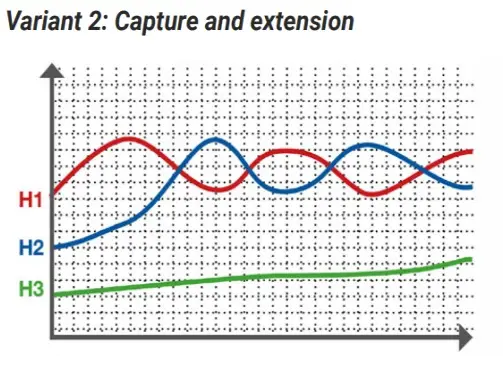
The concept is most easily understood concerning the Three Horizons framework. This encourages us to see a landscape of change in which three patterns of activity play out over time: a shift from the established patterns of the first horizon to the emergence of new patterns in the third, via the transition activity of the second.
The first horizon is the dominant system at present. It represents ‘business as usual’. We rely on these systems being stable and reliable. But as the world changes, so aspects of business as usual begin to feel out of place or no longer fit for purpose. Eventually ‘business as usual’ will always be superseded by new ways of doing things.

The third horizon emerges as the long-term successor to business as usual. It grows from fringe activity in the present that introduces completely new ways of doing things but which turns out to be much better fitted to the world that is emerging than the dominant H1 systems.
The second horizon is a pattern of transition activities and innovations, people trying things out in response to how the landscape is changing. Some of these innovations will be absorbed into H1 systems to improve them and prolong their life, some will contribute to growing a new pattern of activities and the emergence of a radically different third horizon.
A perspective that explicitly recognizes innovation of the system as well as innovation in the system
As the framework with its three lines suggests, all three horizons are always present. Aspects of H1 will persist in any new ‘business as usual’. Aspects of H3 are always evident, if not obvious, in current discourse and argument and all kinds of activity on the fringes of the dominant system. These are ‘pockets of the future in the present’: the future that William Gibson famously told us is already here but unevenly distributed. H2, like a moving border between past and future, is all around us in examples of innovative and sometimes disruptive alternative practices.
But the dominant business-as-usual system’s commitment is to survival. The first horizon system can maintain its dominance even in a changing world either by crushing disruptive innovation or by co-opting it to support the old system.
These typical behaviors lead to variants of the smooth transition depicted above. ‘Collapse and recovery’ sees resources piled into maintaining the old against the grain of a changing world leading eventually to precipitous collapse. More common is the ‘capture and extension’ scenario in which innovations in H2 are ‘mainstreamed’ to prolong the life of the existing system and effectively delay the emergence of the new.
There is also a more positive ‘overshoot’ scenario, in which investment pours into a promising pattern of innovation in H2 before it is ready to meet demand and when quality is variable. This is the tech bubble scenario. The bubble is followed by a bust, but H3 can grow strongly when confidence returns.

It is tempting to read the Three Horizons from short-, medium- and long-term perspectives. Indeed, that is how it was first introduced by a group of McKinsey executives in the 1990s in The Alchemy of Growth. But as a means of getting to grips with complex social change and understanding the distinctive role of transformative innovation, it is much more helpful to understand the three horizons as three very natural perspectives on the future potential of the present moment.
In almost any conversation about change, it is possible to pick up the distinctive ‘voices’ of each horizon. The H1 voice is the voice of the manager. It talks about maintaining the current system and usually expresses anxiety and concern for example about lack of time or lack of resources.

The H2 voice is the voice of the entrepreneur. It talks about trying something different and often expresses a combination of urgency and frustration “Why do we spend so much time going round-and-round in circles when we could be doing something?”
The H3 voice is the voice of the visionary. It talks about dreams and deep aspirations and is usually both humble and inspiring “What gets me out of bed in the morning is the thought that one day we really will be able to deliver this for everyone.”
Transformative innovation is triggered simply by new ways of thinking about and understanding the challenge
Each position can ‘hear’ the other voices either in a negative, competitive frame or in a positive, collaborative one. Becoming adept at listening to these three perspectives in any conversation about change and working with them to shift the conversation in a generative direction is already a key strategic competence.
More important still is the intuitive grasp the framework offers for the distinction between sustaining and transformative innovation. All innovation is disruptive to some extent, introducing something new into the mix. But, if it is to be effective the innovation needs to be absorbed into a wider pattern, adopted into a broader system.
The obvious place for an innovation to find its place is in H1, the dominant pattern. Innovation here is for efficiency speed, reliability, cost, and safety and is about improving what is already there without changing the fundamentals. This is sustaining innovation.
But with a third horizon in view, there is another place for disruptive innovation to land. It can find its place in an emerging, visionary third horizon pattern, just becoming visible on the fringes of the first. Then it becomes transformative innovation helping to shift existing systems towards a new pattern of viability better suited to the future. Think of the difference between a fitter, faster, fatter, safer, more efficient, cheaper caterpillar and a butterfly
Transformative innovation puts the rules, rights, norms, values, and culture of existing dominant systems in question, working towards an intentional vision of a future different from the past, innovating the system rather than innovating within the system. Anyone can disrupt a system just throw a spanner in the works. But we need a third horizon to disrupt it with a purpose.
Transformative Innovation in Practice
The financial crisis in 2008 popularised Herbert Stein’s Law: that “if something can’t go on forever it won’t.” This self-evident truth is a source of deep anxiety for those managers responsible for maintaining the systems people have come to rely on. But it is also the beginning of wisdom. Our task as innovators cannot only be to maintain existing systems. We must also enable the transition to the new patterns that will continue to be effective in the future in a changed world. We need to keep the lights on today at the same time as growing a new system that will keep them on a generation from now. Typically, these twin tasks require an innovation portfolio that contains:
• sustaining innovation to maintain and improve the existing pattern;
• disruptive innovation to experiment with new ideas; and
• transformative innovation intentionally shifting the system towards a new pattern of viability fit for the future.
Transformative innovation is triggered simply by new ways of thinking about and understanding the challenge and therefore rarely needs much resource to get it started. It is surprising then that the transformative element in this portfolio is usually so weak. That can be because of the strong gravitational pull of sustaining innovation: inevitable ‘first horizon’ pressures for maximizing short-term returns in business or ‘doing more with less’ with shrinking budgets in the public sector.
Often all that is needed is some encouragement in an organization for the exercise of the imagination
Disruptive innovation also naturally grabs a lot of attention it is cool, it trends, it is fun, it is energetic, and it delivers results (positive or negative) quickly. ‘Move fast and break things’ is an attractive philosophy at some level and is a very easy mantra to follow. We tend to forget that the classic book with that title was written as a cautionary tale, not an instruction manual.
That leaves transformative innovation, innovation with a future pattern in mind, as the Cinderella at the ball. But without this element in the portfolio, the whole will, sooner or later, be found wanting. That may not matter for a business there are always new avenues to explore and both sustaining and disruptive innovation can generate substantial revenue. But in government and the public and social sectors, there must be a transformative element in the portfolio our long-term survival depends on it.
Often all that is needed is some encouragement in an organization for the exercise of the imagination or for alternative ways of seeing the world. I often ask organizations especially in the private sector to reflect first on their own dominant culture. How is the visionary third horizon voice heard: is it welcomed, is it present, is it actively suppressed, is it invited in to visit, is it invited to leave when it is found within? How might it be welcomed and encouraged alongside the perspectives of the manager and the entrepreneur in a dialogue that is then able genuinely to embrace both short-term success and long-term sustainability?
In the public sector, IFF encourages transformative innovators to think beyond H1 efficiency savings and H2 quick fixes to more imaginative, longer-term, aspirational, and systemic change. In our education work, notably in Scotland, the US, and Australia, that has meant looking beyond current exam success to fostering the ‘21st-century competencies’. In local government in the UK, it involves opening a second front beyond austerity cuts to services, catalyzing small transformative initiatives to grow a new pattern for the future. With the National Institution for Transforming India (part of the Indian government) we have leveraged Gandhi’s encouragement to “be the change you wish to see in the world” to support adding a transformative element to their impressive portfolio of sustaining and disruptive innovation. In all cases, the emphasis is on implementation: successfully introducing the new in the presence of the old.
Health and Social Care
Perhaps our most thorough exploration of the potential for and the practice of transformative innovation has been in the field of health and social care. Throughout the developed world we see inexorably rising budgets due to a combination of advancing technology, aging populations, and more complex patterns of disease (chronic diseases and so-called ‘multi-morbidity’). Health inflation runs at 3 - 4% a year even in the most efficient systems.
Whilst our politics is still conducted based on raising the finances to sustain the present system (e.g. by raising taxes, introducing fees, insurance schemes, private provision, etc), some have concluded that we cannot go on like this. Stein’s Law applies here too.
In Fife, in Scotland, we have been supporting a program of transformative innovation in health and social care for nearly 10 years. It started as a small-scale initiative to work with older people to help look after them at home, drawing on the resources of their local community, family, and friends, as much as on health ‘services’. The pattern of ‘care’ was also configured around their expressed aspirations for the future: concentrating on what they would like to be able to do to make their lives more worthwhile rather than simply assessing for and allocating the standard health and care services available.
The results have been remarkable. The promise was to work with 100 individuals in this way over two years – based on a small ‘invest to save’ grant awarded for a single year’s intervention. At that point, the project suggested it would be possible to close a community geriatric ward and bank considerable savings.
In practice, the program engaged only six older people in year one. An abject failure. But those that were engaged showed the approach would work. So, the program continued. In year two there were 50 still only half the total promised so just an embarrassing failure. Senior managers closed the ward anyway since that outcome had already been written into their plans. Fortunately, in year three the number of older people benefitting from the new approach had grown to 500, and a year later to 5000.
At this point, people started to pay attention. Factor 10 scaling is the innovator’s dream. I recall telling the program team that they would need to get ready for 50,000 in a year. They told me it could not be done: there are not that many older people in Fife.
In practice, the approach mobilizing the community and other resources and the inner motivation of the ‘patient’ to live the life they want to live has continued to grow and spread into other patient groups and sectors. To the point where this new way of working stands on the brink of becoming the new default. Whilst the institutional and organizational reformers are working hard to integrate the complex systems of health and social care, this approach is delivering ‘integration for free’.
We are now in the most interesting phase: navigating ‘the last mile’ in which a distant dream of a new third horizon system becomes accepted as the new normal, the new first horizon pattern, such that resources still locked into the old system can be released to flow into the new.
Rather remarkably, this whole program has involved only a tiny injection of financial resources each year to enable its growth amounting to little more than 1% of 1% of the total NHS budget in Fife each year. The resources tied up in the new way of working in terms of staff time and so on are much larger. The point is that it takes very little to seed a new pattern and to help it gradually enroll other existing resources (IT, infrastructure, training provision, management and staff time, etc) to help it grow over time.

This is how creating the future pattern works. To shift a culture, you have to start by doing something counter-cultural (H3 in the present). However such innovation can only be sustained if it is absorbed into a wider pattern of self-reinforcing activities. It cannot survive for long on its own. Just as we as people live in a pattern of relationships, so do projects. Any new project, any new pocket of innovation, needs to combine with other innovations, other projects, other activities, and structures to become established as part of a new H3 pattern that has the internal coherence to maintain itself over time.
Transformative innovation at scale is ultimately about moving from project to pattern. It is a distinctive practice and an essential one
The veteran scholar of evaluation Michael Quinn Patton puts it well when he observes that future-facing innovations that ‘succeed’ have usually found some protected space outside the dominant system where they can be assessed on their terms, while those that fail have usually been judged by mainstream standards and found wanting. In either case, Patton points out, we must draw the same conclusion: projects do not change systems. This confirms my own experience. It is patterns that change systems because patterns are systems. Transformative innovation at scale is ultimately about moving from project to pattern. It is a distinctive practice and an essential one. In today’s powerful times, I am encouraged to see more and more organizations starting to take it seriously.


