Post-war growth in Italian GDP was led by large State-owned public companies like IRI, ENI, and ENEL. Today the only Italian global players are still in the hands of the State, the others have either delocalized or disappeared. In this period of renewed recovery funds and a greater role in national planning, there is much to learn from them. The renewed role of the State needs to be well-understood in generating peaceful cohabitation in a moment where inequality and social cohesion are (or should be) at the core of any public policy which is worth that name.
When people think of the Italian economic miracle, they think of La Dolce Vita, the paparazzi, the FIAT 500, and possibly the Olivetti Lettera 22 typewriter. They rarely link this miracle to the role that the State played in making Italy recover from the desperation and devastation of the fascist regime and the Second World War. Even less is known about the role that the Vatican and the Italian Catholic elite played in such a success. There is another story that is to be told and it is a story that links economic growth and innovation, social development and cohesion, and accounting innovations and religious credos. This other story is less known but has the State as a key institutional actor, it is animated by enlightened and committed intellectual figures and has a clear plot that links the economy to social development and the Catholic ideal of common good.
Think of Italy after World War II (WWII). The country is very fragmented geographically, economically, and socially, with considerable tension emerging from the liberation civil war, a considerable north-south economic and social divide, and the remnants of the influence of the city States. The global geopolitical context was no simpler, seeing Italy falling under US influence while still having the largest communist party outside the USSR and the presence of the Vatican, which was institutionally reduced to a tiny state but practically present in every aspect of Italians’ life from family to work.
Italy has always been a land of institutional complexities, contradictions, and divides but also a country with significant innovation both in the arts and in business. How did Italy manage to successfully recover from WWII in a situation that presented such layers of complexity?
The State, democratic expression of a proportional electoral system through the parties represented in Parliament, defined the vision for the Italian economy and society
A key role was played by the Economic Recovery Plan, commonly known as the Marshall Plan. This is a well-understood story, with Italy’s role similar to that of many other countries in the rest of Europe. What is less well-known is how Italy managed those funds flooding into Italy, what it did with them, and above all why, how, and with what purpose?
This less-known story begins in the early forties when a little-known but very significant figure, Sergio Paronetto (1911-1945), under the input of Giovanni Battista Montini, later known as Pope Paul the VI, began to encourage the Italian Catholic intellectuals to design the contours of modern social democracy for postwar Italy. For the Vatican, it was already clear in 1940 that entering the war for Italy and the fascist regime was a tragic and strategically wrong decision. Paronetto, a leader of a movement that gathered Italian Catholic graduates, hosted a series of meetings known as the ‘Meetings of Via Reno’ (from the address of his home in Rome) to outline the contours of a new Catholic social doctrine. Important political, religious, and economic figures took part in these meetings, including Alcide De Gasperi (the founder of the Christian Democracy (Democrazia Cristiana, DC), who would have then become the first Prime Minister of the Italian Republic), Giulio Andreotti (later seven times Italian Prime minister and possibly the most important political figure of twentieth-century Italy), and many other relevant figures who would have then become part of the Italian establishment and played key roles on the international scene. These meetings then led to the publication of the Code of Camaldoli (from the monastery in Tuscany where the final meetings took place) which encapsulated in the ideal of common good the rules of conduct for Italian Catholics in all spheres of their lives, from individual to social and economic behavior. The common good was interestingly defined as those conditions that allowed the pursuit of individual interests, thus allowing individuals to pursue their dreams but constraining their actions by allowing others’ interests to be pursued as well. Figures like Aldo Moro (the leader of the DC then killed by the Red Brigades in the seventies) took part in the meetings leading to the publication of the Code and with Andreotti and some other participants, influenced the works of the Constitution Assembly that would have embedded most of the Catholic ideals of the Code into the Constitution of the Italian Republic promulgated in 1948.
It was in the context of these activities that Paronetto met two figures, both from his original birthplace, Morbegno in Piedmont, who with him would have become key in the design of the architecture of the Italian economic miracle. The first character is Pasquale Saraceno (1903- 1991), an influential academic and key top executive of the Istituto della Ricostruzione Industriale (IRI), the public holding company that would have administered the funds of the Marshall plan, and Ezio Vanoni (1903- 1956) later minister of Finance and of the Treasury. Paronetto, Saraceno, and Vanoni wrote the whole section of the Code concerning the economic doctrine of the Catholics and realized such doctrine through their professional work: Paronetto and Saraceno at IRI (where the former played various roles until his appointment to Vice-Director near to his premature death, and the latter as head of planning and budgeting), and at the government (through various institutional roles held by Vanoni).
What was IRI? And why was it so important for our understanding of the Italian miracle? and more importantly, to understand how to pragmatically and effectively coordinate state intervention in designing strategies for recovery within a market economy.
IRI is the center of this other story. It became the locus where the Catholic ideal of the common good became concrete through a mix of public policies, state entrepreneurialism, and innovative budgeting and planning solutions. Such solutions embedded the ideal of common good, which also inspired the Christian Democratic social policy in post-war Italy, and refused the corporate ideology of profit, while still providing social and economic development in a market economy. IRI was founded by Mussolini in 1933, to respond to the 1929 great financial crisis. Originally aimed at restructuring the banking sector, its bureaucratic organization was then used after the war to manage the recovery fund and the new Italian Renaissance. The institutional architecture of the new IRI was designed by Saraceno. IRI was a state-owned public holding which held stakes in companies publicly traded on the stock exchange or owned by both State and private partners. The IRI formula, which inspired similar solutions in the UK (e.g. with the creation of the Industrial Reorganization Corporation and the National Enterprise Board) in Spain (with the creation of the Instituto Nacional de Industria), and in Japan, aimed to find a third way between US corporate capitalism and the State central planning solutions of the communist ideologies. In the fifties and the sixties, IRI generated several points of Italian GNP, owning and managing companies such as Alitalia, Finmeccanica (currently Leonardo, still partially owned by the Italian Treasury), Fincantieri, Autostrade, Alfa Romeo, SIP (the Italian equivalent of BT), to name but a few. Planning and budgeting at IRI meant defining the economic, industrial, and social policy of Italy.
IRI was the pragmatic institutional solution to mediate between US liberalism and communist central planning, where the State, democratic expression of a proportional electoral system through the parties represented in Parliament, defined the vision for the Italian economy and society (through the Parliamentary and political debate informing the action of the executive power through the Ministry of the Public holdings) and the market would efficiently realize that vision while correcting market production and distribution anomalies thanks to the supervision of the State (and some innovative accounting solutions). Ideologies of common good and institutional solutions need concrete practices to become real otherwise they remain abstract, or worse, deliver the opposite of what they are supposed to. For the IRI model to become real and operationally effective it required new forms of budgeting and planning that did not see the pursuit of profit as their main aim and design principle.
The idea of organizing the income statement in a way that privileged the calculation of profit in the exclusive interest of one powerful stakeholder (the capitalist) was not acceptable
Getting to this solution was not easy as financial aids are never free from attached strings. When US aid arrived in the early fifties, the Americans offered money but also management knowledge. They came with their baggage of managerial and accounting solutions, based on the primacy of the shareholders and their interest, an idea of governance and management that was centralized and saw in the maximization of profit as the cornerstone of the managerial edifice. These solutions clashed strongly with the Catholic ideal of the common good that viewed the family and the community as the institutional cornerstone not only of society but of any form of collective action. This sense of community inspired the hearts but also the hands of Saraceno, of the Christian Democrats (of which Saraceno was a member of the directorate), and of the Vatican. If one thinks of the structure of the Income Statement as we are used to conceive of it, nobody would see it as not an economic but a political statement. Nobody would see that its design emerged during the Industrial Revolution, with the organization of the corporation in functions (i.e. manufacturing, marketing, finance), and refined later with the separation between ownership and management, with the latter working in the sole interest of the former (see Figure 1.1).
We nowadays take for granted that profit is the ultimate calculative aim of a P&L. But this was not the case in the Catholic Italy of the forties and fifties. The idea of organizing the income statement in a way that privileged the calculation of profit in the exclusive interest of one powerful stakeholder (the capitalist) was not acceptable, it would have alienated the workforce and the powerful unions and, above all, go against the ideal of the common good. The solution was found in a system of budgeting and planning based on value-added (see Figure 1 for a comparison between the conventional format of income statement based on a functional understanding of the business and one based on value-added).
After the creation of the Ministry of Public Holdings (Ministero delle partecipazioni Statali) in 1956, under the Direction of Vanoni, the State-owned public holdings (IRI, and then ENI and ENEL) would have sent to the Ministry a report based on value-added principles, to assure the comparability between national accounting and company accounts. To make coherent policies at the state level with actions at the corporate level, IRI’s planning and budgeting were also organized according to value-added. Pro-forma income statements based on value-added principles became platforms of innovation as they allowed debates and mediation between various interests (e.g. the interest of shareholders, as an expression of the interest of the capitalist, the interest of the workers, as the expression of labor as another key production factor) that would have not otherwise been possible with a conventional income statement.
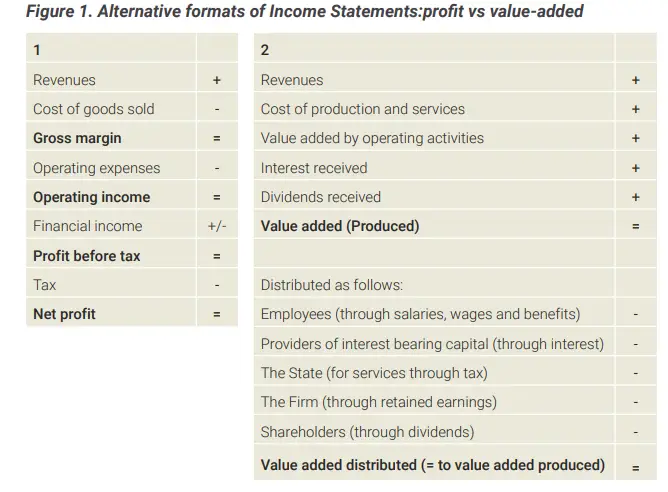
Pro-forma income statements based on value-added principles became platforms of innovation as they allowed debates and mediation between various interests
When defining how to generate revenues to calculate the ‘value added produced’, IRI’s managers, in collaboration with the government, had to decide where to invest. In which sector? Infrastructures? Chemical? Telecommunication? Defense, Automotive? And, more importantly: where geographically? In the industrialized north (an obvious decision from a purely financial point of view, given the greater efficiencies) or in the South, thus mitigating the North-South divide? Similarly, once the value was produced, the debate would move to how to distribute that value to remunerate the various production factors and parties that contributed to its production: capital (in its double form of equity and debt, through interest paid and dividends, respectively), labor (through salaries), the State (through taxes, thus allowing the pursuit of even more socially oriented actions), the firm itself (through retained earnings), which in the Italian approach to management studies was the locus where the pursuit of personal interest should happen in the respect of the common good?
What this handful of Italian intellectuals managed to achieve by skilfully combining Catholic moral credos, a vision of modern social democracy, and unusual attention to institutional details, pragmatic solutions, and accounting innovations was the definition of the institutional and practical infrastructure through which the Italian miracle happened. Possibly the greatest lesson from this other story about the Italian economic miracle is that ideals and visions will not go far if they are not supported by concrete institutional and accounting solutions that make such ideals and visions realizable and real. If one only accounts for profit, one will not get social value, one will get value for the shareholders. Value-added accounting at IRI did just that, it provided a platform where to debate and make real the abstract dream of pursuing the common good by mediating individual interests. That was indeed a miracle.