





Purchase this article as a standalone PDF with full colour magazine layout
As individuals, we know what it is to feel energized. In this state, we are filled with enthusiasm and positivity. Life feels good, and this is reflected in the effort we devote to the task at hand. Organizations with high levels of positive energy are resilient and consistently deliver great results. Highly energized employees are happier and more fulfilled1. As a business, therefore, it stands to reason that creating the conditions in which people feel energized should be a primary strategic focus.
The scientific definition of energy is “the capacity to do work”. Even the word itself embodies the sense of action. The Greek roots, “ener” + “geia", means move to action. The question is: “How do we create more capacity, more energy in our organizations?”
A tale of transformation
Over the past few years, we have been working with an AIM-listed organization. When we were commissioned by the newly promoted CEO, the company’s results had been stuck at the same level for five years. They were profitable, but only just, and there was significant shareholder pressure to up their performance.
We started with the individual members of the exco. Using the Energising Leaders Triangulation® methodology, we helped them understand and articulate where they individually get their energy from. We then used this data to help them get the best from each other. The insights led to reallocation of responsibilities and a new alignment around the ambitions and goals of the organization.
Next, we measured the impact of the leaders on the organization, focusing on how they might do more to energize their people, and we used “organizational acupuncture” (more on this later) to embed the disciplines and habits that unlocked the potential for growth. The year-on-year results show a 25% increase in sales and a 71% increase in profit before tax.
Intuitively we know that energy matters. The evidence supports this intuition. Leadership energy levels correlate with financial performance 2. Energy fuels organizations’ success. Data from a global survey of 250+ companies showed that high energy leaders were approximately four times more profitable than low energy leaders3. Thus, the well-known formula “Strategy + Execution = Results” might better be cast as:

The CEO of the AIM-listed business describes himself as the “Chief Energy Officer”. This reflects the power that we have as leaders to influence the environments we create for our people. The starting point is to recognize that leadership is about our followers and that we need to create the conditions in which they will do great work. Recognizing this leads us to focus on how we create roles and delegate tasks in such a way that our people are energized.

Like a hot air balloon, organizations need to be constantly re-energized to maintain their altitude, and if they are to go higher, the energy levels must be substantially increased. To increase results, you need to increase the level of leadership energy, which in turn shifts the organization's energy, leading to higher levels of customer service and profitability. See diagram above.
Research by Zenger Folkman4 has identified the two most powerful leadership levers as “Drives for Results” and “Inspires and Motivates Others to High Levels of Effort and Performance”. These are displayed by exceptional leaders, defined as those who deliver results in the top 10% of results in their industry. To understand what this means in practice it is helpful to look at the measures for each of the levers:
The measures for Drives for Results are:
The measures for Inspires and Motivates are:
When we look at the data the strongest results are created when both “Drives for results” and “Inspires and motivates” are deployed. Statistically, if a leader has only one part and not the other at a top quartile level, the chances of delivering top decile results are approximately 12%. However, when the two are combined the chance is not 24%, but 74%!
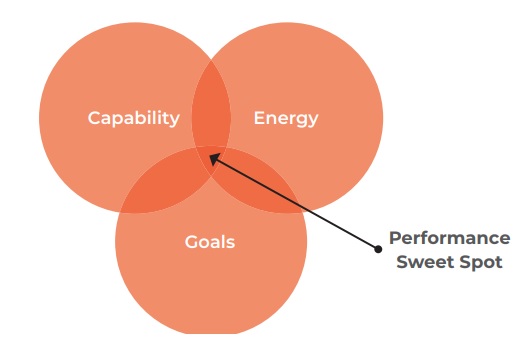
The sweet spot lies in the intersection between capability, goals and energy. When all three are present, our organizations operate at peak performance levels.
The new CEO set clear goals for the organization, focused on winning new customers and a regional focus on the US as the primary growth market. Key appointments strengthened the leadership team and market-leading software was deployed.
The exco were re-energized using our Triangulation® methodology (more on this below). Together these actions moved the organization into their performance sweet spot.
It is important to recognize that energy means both the capability to do work and power in active use. Without doing (enactment) energy is merely latent potential. The feeling and experience of being energized applies in both cases but results only come from action.
Our actions need to reflect a deep understanding that energy comes in different forms and that there are different drivers of energy for people and organizations, which lead us to commit energy in different ways: spiritual, physical, intuition, cognitive, and emotional5.
S - spiritual energy is the power of connection with deeper values and a sense of the purpose of human life.
P - physical energy is the fitness of our bodies, not just of muscles and limbs b, but also thinking, feeling, nd spiritual connection.
I - intuition energy is the power of coming to know without conscious effort, of imagination and spontaneous creativity.
C - Cognitive energy is the power associated with thinking. Through making intellectual sense of things, recognizing and realizing things, analyzing and critiquing things, seeing patterns, and finding the way through.
E - emotional energy is the force of positive feelings such as happiness, confidence, optimism, and eagerness. It can also derive from negative feelings such as anxiety, fear, and sadness.

These different types of energy are reflected in the drivers of energy for people and organizations. We commit energy based on elements such as our:
In addition, other elements such as the organizational culture, values alignment, the levels of trust, or ethical behaviour influence our willingness to give our energy to the endeavour.
Whilst it is possible to survive in the short- and medium-term, extended periods of stress lead to a long-term decline in performance.
The practical work of energizing leadership is to use our own energies, individually and collectively, to intentionally influence the energies others are prepared to commit to organized effort. This involves mobilizing, focusing, refreshing and refocusing energy6. Energizing leaders:
There are three areas to look at when thinking about energy and leadership. To be effective in maintaining and increasing the organization's energy, leaders need first to pay attention to their own energy levels, “personal energy”. This creates the capacity to energize others, particularly the teams they lead, “interpersonal energy”. Leaders at every level have the power and resources to influence the energy across the whole organization, “systemic energy”. The three areas are represented below:
1. Personal - energize self
Leaders need to take care of their own energy, mental, physical, spiritual and emotional. In turbulent times this can be difficult to do. The pressures of work and demands of home life often mean that personal care suffers. Whilst it is possible to survive in the short and medium-term, extended periods of stress lead to a long-term decline in performance.
Post-COVID organizations have become much better at paying attention to the well-being of their people. There is a wide range of help available. The secret is to take action to avail yourself of the help.
Energy is also about capacity and capability. Focusing on playing to strengths and continuing to invest in learning to develop new skills, disciplines, and habits creates new energy to input into the system. Creating clear and compelling personal goals and ensuring these are aligned with their role in the organization underpins the capacity to energize the organization..
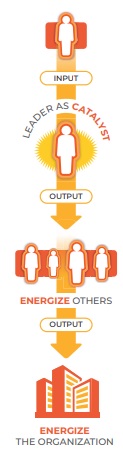
2. Interpersonal - energize others
Since leaders are the primary catalysts in determining the level of organizational energy, they need to be able to inspire and motivate and energize the people they lead authentically. This means the leader needs to invest in understanding and being able to articulate what makes them special, their “superpowers”. Psychometric instruments are helpful in both revealing what these are and giving a language for expressing them in words that are both accurate and accessible to others.
When deployed across a team, this creates a shared language that supports effective collaboration. In our experience it is rare that leaders and teams take the time to deeply understand each other’s motivations and sources of energy. If we imagine members of a team as ‘cogs’ that mesh with one another, a lack of understanding means the cogs rattle against each other, losing energy in the process. By investing in creating genuine understanding and mutual appreciation, team interactions become more efficient and effective, leading to better decisions made more quickly.
There is a persistent myth that strong leadership means being good at everything.
3. Systemic - energize the organization
Without energy, organizations cannot function, yet we do not typically design our organizations to deploy energy efficiently and effectively. Indeed, the common experience of leaders is that they must spend time and energy compensating for organizational features that waste, divert, and disconnect human effort.
Energizing leadership is therefore distinctively different from general resources management, project management, time management, and human resources management etc. The desired result of leaders operating as catalysts is an energized and capable organization, aligned behind a shared ambition, delivering results today, whilst transforming for the future.
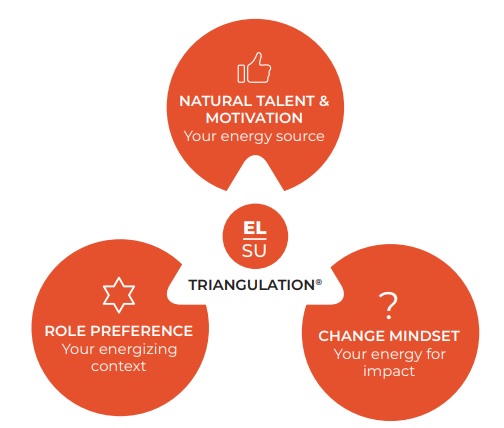
To achieve this desired outcome in the AIM-listed company we used data to pinpoint the strengths of a leader and the members of their team. The Energising Leaders Triangulation® approach uses three different lenses to bring the individual into clear focus:
We calibrated their:
What energizes you?
Energy and drive come from the use of our natural talents in pursuit of our goals. Leaders who know what drives them remain energized no matter what the challenge.
We mapped each leader’s natural talent set to find out what motivates them to come to work and helped them identify the top 10 strengths they should play to, pinpointing the source of their energy and drive.
Where are you most energized?
There is a persistent myth that strong leadership means being good at everything.
The Zenger Folkman research data shows that great leaders are exceptional in a few areas and know how to leverage these strengths to deliver results. This translates into a strong preference for a particular role in the organization or a certain part of the business lifecycle.
By mapping leaders’ preferences across possible roles in different stages of the business cycle, we identified where they perform at their best and then helped them to maximize their contribution within their preferred role.
The focus on energy as the fuel that propels the organization is a powerful unifying idea that focuses on the “so what” of leadership, delivering exceptional performance.
Where does your energy go?
In making things happen, the leader’s mindset and energetic focus are mission critical.
Everyone has embedded, unconscious patterns of thinking that show up in their behaviours. When seeking to make things happen, these patterns are at play. When aligned with the leader’s energetic strengths and with the needs of the business - great things happen.
We revealed how the leader and the team go about making a big impact in their organization and focused them on doing more of this more of the time.
Engaging with intent
Leadership is a “contact sport”. By this, we mean that it primarily takes place when we engage with others, face-to-face in the room or online. This means that energizing leaders must be adept at engaging with others. This matters because it affects how people:
Leaders who are effective in engaging others do this intentionally. They have developed conscious competence in exercising their talents and skills in an authentic way. They take the time and make the effort to really get to know the people they lead. The use of data brings precision to this engagement and when deployed across teams and teams-of-teams, it creates a shared language that accelerates the capacity to make better decisions, faster.
Intent v. content
As leaders, we tend to judge ourselves by our intentions. Others judge us by our content, that is, how we actually show up. As human beings, we mostly assume that what inspires and energizes us will also inspire those with whom we interact and this can reduce the impact of our good intentions.
We measure the degree of alignment through powerful 360 tools, which compares our own thinking with the perceptions of those we lead. On occasion the differences can be significant. When this happens the power of the insight is highly diagnostic and unlocks hidden potential for performance.
The AIM-listed company’s data revealed that the organization's culture valued the creation of the perfect product over the achievement of sales through driving for results. This led to a conscious shift in focus supported by appropriate financial incentives.
Effecting change
In a world where people and organizations live in a state of semi-permanent overwhelm, large-scale interventions are rarely successful. We need therefore, to think differently about change. In recent times, there has been an increasing recognition of the power of small shifts that create a big impact over time. Books such as Atomic Habits (James Clear) and Tiny Habits (BJ Fogg) reflect this new understanding and approach. This context demands a different approach to systemic change, which we call “organizational acupuncture”.
Acupuncture works by stimulating the body’s natural resources to restore and maintain health. Organizational acupuncture uses simple micro-interventions to stimulate the organization’s health. These micro rituals or habits have been shown to deliver multi-order impact over time.

EDiBLe Creating a learning organization
One example that we deployed as part of the AIM-listed company transformation is the “EDiBLe” ritual. This consists of four short questions for reflection:
“What was Exceptional (content and process)?”
“What, if anything, was Difficult?”
“What would be even Better next time?”
“What can we Learn?”
When this ritual is completed after every meeting, the organization is self-assessing against a high standard (what was exceptional?); has permission for there to be difficulty; is focused on continuous improvement (even better?) and is encouraged to reflect (what can we learn?).
Experience shows that simple behavioural shifts driven by new rituals and habits have powerful positive effects. A simple habit has the capacity to deliver multiple benefits at the personal, interpersonal and the systemic level.
Closing reflections
Business is typically driven by self-interest. It is in the interest of organizations to have high levels of human energy committed to the realization of their ambitions. The reality, however, is that most working environments are not highly energized or, if they are, it is not infrequently a negative energy.
Organizations that focus on positive energy as well as driving for results are more likely to thrive in turbulent times. Leaders who inspire and motivate their teams re-energize them. Employees who are energized in pursuit of a compelling goal rarely look outside the organization and bring elevated levels of discretionary effort to their work, which leads to higher levels of profitability.
The focus on energy as the fuel that propels the organization is a powerful unifying idea that focuses on the “so what” of leadership, delivering exceptional performance. As we continue to face new challenges, it becomes increasingly important to understand and act on the insight that leaders have the capacity to catalyze new levels of energy. This creates a “win/win” where energized people in energized organizations deliver profitable results in a context where they truly thrive. As a result, what is good for business is ultimately good for society.


