







Today’s world is characterized by challenges and uncertainties, such as climate change and the associated environmental disasters as well as resource scarcity, military conflicts, inflation, and political instability. The dynamics unleashed by these crises are changing the economy and how value chains and co-operations work worldwide. In addition, new technologies such as artificial intelligence and cloud computing are having a major disruptive impact on all business models.
In this rapidly changing and increasingly demanding global context, companies and nations have to prove their competitiveness and ability to innovate time and time again. Creating continuous innovations is a must if we want to ensure a sustainable, prosperous, and progressive society in the future.
With their ability to react quickly to new circumstances, start-ups are in particular a driving force for innovation. Universities play an important role as a source of talent and technological innovation. With the right mechanisms, insights and solutions from research can be quickly introduced into practice via start-ups so that cutting-edge technologies become new products and services, and tangible value is created from academic research. In addition, start-ups have become an increasingly indispensable innovation source for established companies, which are eager to collaborate and engage in entrepreneurial partnerships.
Munich’s UnternehmerTUM – a Benchmark Innovation Ecosystem
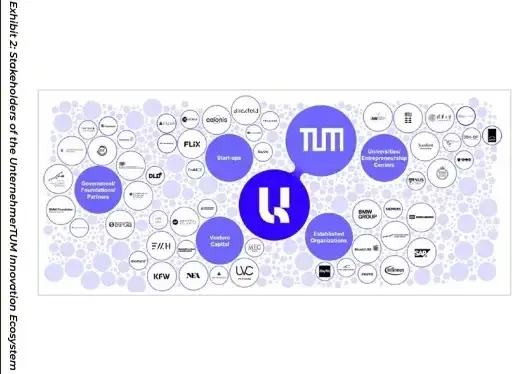
In our experience, the key to promoting innovation and new technologies lies in creating a dynamic network that connects the stakeholders who are instrumental for success: established companies, universities and research institutions, start-ups, and politics. Designed well, such a network will create a strong business cluster. Co-operation across cluster boundaries is crucial for economic success.
The Munich metropolitan region is an excellent example of such an innovation ecosystem which is well-designed and utilized. With top universities such as the Technical University of Munich (TUM) and Ludwig-Maximilians-Universität (LMU), non-university research institutions like the Max Planck Society, global businesses like BMW, Siemens, or Infineon, and a large number of agile tech start-ups, Munich has become an attractive location for top international talent. The enriching interplay of competition and strategic cooperation creates a unique ecosystem that promotes and drives innovation. In this dynamic environment, UnternehmerTUM - the entrepreneurship center at TUM - acts as an enabling platform for the various players.
Since its founding in 2002 by German entrepreneur and BMW heiress Susanne Klatten, UnternehmerTUM has established a systematic spin-off process to bring innovative companies to the global stage and attract key players in the technology sector. Over the years, it has grown to become the largest start-up and innovation centre in Europe. Today, the entrepreneurship centre employs over 400 people (FTE) and supports more than 50 high-growth technology start-ups per year, making it a key player in the European innovation arena that provides an important contribution to a dynamic start-up ecosystem.
In 2022, the influence of TUM and UnternehmerTUM reached a new benchmark: over 20 percent of Germany’s venture capital volume - more than 2 billion euros - flowed into start-ups supported by these institutions. Notable success stories include unicorns such as Celonis1, Lilium2, Flixbus3, and Personio4, all of which are part of this success story.
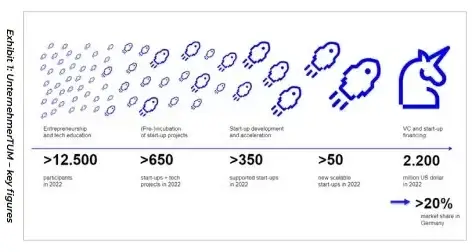
UnternehmerTUM transcends traditional funding structures and offers a comprehensive range of activities for individuals at all stages of the start-up process. From hackathons and marathons to talks and seminars, the organization promotes a hands-on approach that provides aspiring entrepreneurs with practical insights and experience, supporting entrepreneurial minds throughout their entire start-up journey.
The roots of this success lie in a collaborative ecosystem that brings together companies, SMEs, universities, research centers, and service providers in and around Munich. This powerful network not only facilitates innovation; it also creates synergies: large companies benefit from the inventive spirit of start-ups, while start-ups find ways to expand through strategic partnerships with established companies.
The City of Munich, the Bavarian State Government, and the Federal Government have recognized the central role of UnternehmerTUM and TUM as leading entrepreneurial institutions. This has led to a close and productive partnership at various levels to jointly shape the future of technological innovation and the success of start-ups. For example, as part of its national innovation strategy, the German government intends to build 10 more startup factories in Germany - under the role model of and in collaboration with UnternehmerTUM.
Tackling the challenges of today
Considering the big challenges business and society are facing, the need for sustainable innovation has never been greater. Responding to this need, UnternehmerTUM has set up in recent years several initiatives to bring about innovations for economic and social change.
Circular Republic
One important area of innovation we address in this context is the Circular Economy. As we grapple with the drawbacks of a linear economic model that proves to be inherently unsustainable, the call for a transformative shift towards a circular economy has become increasingly evident.
The circular economy redefines our approach to consumption and production by promoting sustainable practices such as sharing and recycling. Shifting to this model benefits both industry and society by conserving natural resources, reducing waste and emissions, and creating novel economic opportunities.
Companies that embrace the principles of the circular economy benefit from efficiency, cost reduction, and increased competitiveness. Start-ups, with their innovation and agility, play a crucial role in driving this change. For this reason, UnternehmerTUM has launched the CIRCULAR REPUBLIC initiative with corporate partners such as BMW, Prezero, SAP, and Tengelmann.
CIRCULAR REPUBLIC serves as a catalyst for sustainability, from electric cars to recycling innovations. Startups such as Made of Air and FINN are contributing to the circular economy.
Venture LabsAnother initiative are the TUM Venture Labs that are designed to further promote and expand the translation of cutting-edge research into marketable applications. TUM Venture Labs support TUM scientists and students even more deeply in the spin-off of companies in various technology-based fields at the interfaces of engineering, natural and life sciences, artificial intelligence, and medicine, offering founders a comprehensive ecosystem with the necessary development environments. The offer ranges from technical and social infrastructure such as workplaces, laboratories, and workshops to entrepreneurship training and support from a network of companies, mentors, investors, and scientific experts.
Leading deep tech start-ups to success requires a deep understanding of the focus technology, which is why we created Venture Labs in various deep tech verticals. Eleven Venture Labs have been set up since October 2020. They work in the areas of software/AI, robotics, quantum, aerospace, built environment, chemistry, healthcare, food/agro-biotech, additive manufacturing, mobility, and sustainability/circular energy economy.
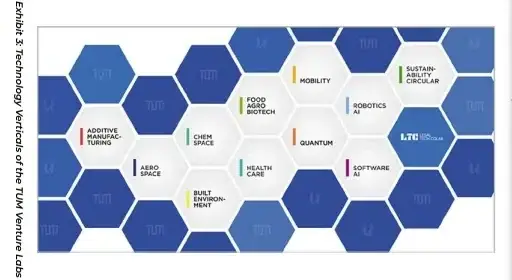
In the second year since its foundation, about 250 start-up teams are already being supported by the Venture Labs. This way, the labs create dynamic ecosystems from which not only individual companies can emerge, but also entire start-up families. The initiative aims to strengthen cooperation with other universities and also become a model for startup creation at German universities.
Focus on the Family
Germany is known for its “Mittelstand”, with its hidden champions and family businesses. They make up a large part of the national value creation and economic growth, and they must remain innovative as a backbone of Germany’s industry. After all, family businesses generate over 50 percent of Germany’s gross domestic product.
Familien Unternehmer TUM One of the focus fields of the entrepreneurship center, has set itself the goal of strengthening German SMEs and thus contributing to Germany’s innovative strength and prosperity for future generations. The initiative aims to closely network SMEs with start-ups and the research community in a pragmatic and output-oriented way. By teaming up, digital transformation and especially the application of artificial intelligence as well as the adaptation of new technologies get implemented faster and more efficiently. Roadshows, scouting and matchmaking programs, accompanied pilot projects and joint financing and scaling efforts support the joint value creation process.
At UnternehmerTUM, family businesses not only find start-ups and other established companies as collaboration partners. The entrepreneurship center with its infrastructure and community is also a space for experimentation. Participating companies can send their innovation teams to our facilities and be part of the creative work environment. They are exposed to hundreds of other innovators, researchers, students, and entrepreneurs and receive new inspirations by connecting to an interdisciplinary community. This meeting market and deal-making environment leads to a continuous flow of new joint innovation projects and ultimately win-win success stories.
Rise Europe
In an era characterized by interconnected global economies and shared environmental challenges, collaboration across national borders has become essential. Achieving both economic prosperity and environmental sustainability requires concerted efforts and collaborative partnerships between key players in the innovation system. In this context, Rise Europe is an important initiative.
Launched in May 2023 by UnternehmerTUM, DTU Skylab, and the Paris-based incubator Agoranov, Rise Europe is a pan-European network composed of leading developers of start-up ecosystems. The mission of this collaborative effort is to promote European start-ups and provide them with the support and resources they need to thrive in a competitive and dynamic landscape. With representatives from 14 European countries, Rise Europe seeks to accelerate the growth of start-up teams and contribute to the development of European technological sovereignty.

At its core, Rise Europe is dedicated to tackling critical transitions and global challenges, including the climate crisis and resource scarcity. By supporting startups who are committed to creating a safe, prosperous, and future-oriented society, the network aims to make a significant impact at both a regional and global level. Through a combination of strategic initiatives, mentorship programs, and access to an extensive network of resources, Rise Europe strives to position European start-ups as catalysts for positive change.
The members of the Rise Europe network are united by a shared commitment to pool their strengths and create an environment where innovation thrives. The goal is to match the innovative power of the United States and China and to bring European start-ups to the forefront of the international scene. Rise Europe aims to reshape the history of European entrepreneurship and contribute to the continent’s economic and technological leadership by facilitating their scaling-up and transformation into sustainable global leaders. In doing so, we strive to create a legacy of innovation that transcends borders and shapes the future of the global start-up ecosystem.
The numbers speak for themselves: In 2022, Rise Europe’s 20 European start-up hubs inspired a total of 38,000 young talents and students across Europe to start their businesses, and they supported 2,300 up-and-coming ventures in their development phases. The idea behind these efforts is to inspire the next generation to think and act entrepreneurially across national borders.
Rise Europe’s shared platform concept enables founders to benefit from a diverse range of resources and offers. With a total of 7.8 billion euros invested in the supported start-ups, these 20 European entrepreneurship centers make a significant contribution to the economic vitality of the European start-up scene. This amount of funding corresponds to around 10% of total investment in the European tech industry The members of Rise Europe have each nominated ten start-ups that they believe have the greatest potential to become the next “start-up champions”. These scale-ups - including Fernride from Germany, IQM from Finland, and Ynsect from France - are characterized by their growth and positive impact on the environment and society. The nominees have been assigned to four fields, reflecting the potential that Europe has in these future areas: aviation and mobility, artificial intelligence and robotics, energy, climate neutrality and circular economy, and health and food d (see exhibit 4) This overview underlines the important try, family offices, political institutions, and investors to improve the environment for entrepreneurial initiatives in Europe and provide start-ups with easy market access to talent, customers, and capital across Europe.
Outlook
Start-ups, characterized by their speed, adaptability, and privileged access to cutting-edge technology, play a central role in promoting innovation and the rapid market introduction of new products and services. Recognizing the potential of start-ups as engines of economic growth and technological advancement, there is a growing emphasis on creating an environment that encourages and supports entrepreneurial initiatives, especially those emerging from higher education institutions.
If we want to strengthen the entrepreneurial ecosystem and facilitate the seamless transition of spin-off teams from academia to industry, we must professionalize existing support structures and processes. This includes developing comprehensive frameworks that provide guidance, mentoring, and resources to these burgeoning start-ups and ensure that they navigate the complexities of the business landscape with confidence and competence.
But this alone is not enough. The optimization of the transfer of intellectual property from universities must be accompanied by a stronger financing landscape in Europe. Such a financial infrastructure is a key success factor when it comes to developing new European innovation champions. To achieve this, more venture capital must be made available for start-ups in Germany and Europe, for example by unlocking financial resources from insurance companies, pension funds, or foundations.
UnternehmerTUM started out as a regional Bavarian initiative, supported by an influential and wealthy entrepreneurial visionary. From the outset, it followed an emphatic network strategy, connecting entrepreneurs, academia, government, established businesses, and funding sources, and providing a unique development and support infrastructure for start-ups. Today it towers as a global benchmark of an innovation ecosystem that has few, if any, peers. With Rise Europe the journey now enters a new, exciting level: the ambitious and important project of raising the full entrepreneurial potential of Europe which will create a new generation of market and technology leaders.


