





Today’s start-up ecosystem is abundant with resources specifically tailored for women: women-led VCs, women-focused Angel Networks, professional women’s entrepreneurial organizations, incubators, accelerators, coaches, and a variety of government and private grants for women-led businesses. Despite this comprehensive range of support, which has been growing for years, a pivotal question arises: what has been the impact?
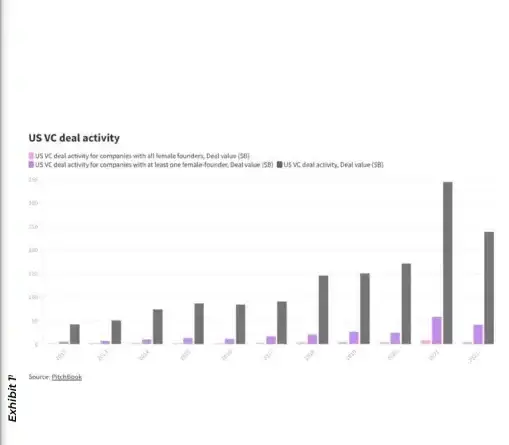
An analysis of the investment activity of US-based Venture Capital reveals that funding of female-led startups is not growing; it has decreased from 2021 to 2022 (see the pink bar in Exhibit 1). There is some growth with mixed male and female teams (purple) but there is little transparency on what that means from an equity parity perspective. While there are more female-led teams in raw numbers, male-led startups are getting 98% of the funding.
Funding for female-led start-ups is not growing; it has decreased from 2021 to 2022.
Why, despite all the efforts to increase funding to women, is the needle not moving? What is the root cause that lies behind the lack of opportunity for female founders to get a bite at the success apple? To answer this question, let’s first take a closer look at the current paradigm of the entrepreneurial support system.
A Broken Paradigm
Funding for women and underrepresented founders is undoubtedly crucial. However, our intense focus on this issue makes us blind to the bigger systemic factors driving disparities. In 2022, roughly six thousand companies exited globally; if half of them were women-led, it would be a substantial win. Yet, it would merely be a drop in the massive ocean of failure that engulfs the universe of founders, and that goes largely unnoticed.
Imagine if these were the statistics for higher education, where 99.9% of all degree-holders were unemployed. We would be scrutinizing the system failures, not the individuals.
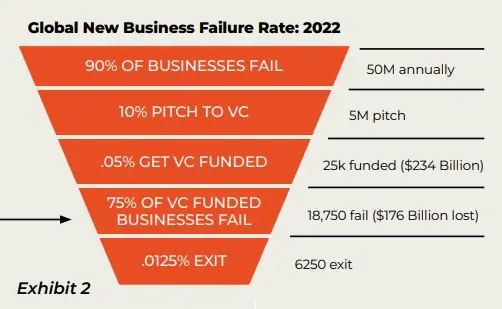
Consider the numbers: in 2022, 50 million businesses were founded globally. An astonishing 90% of these emerging businesses fail. Only 10% (5 million) manage to reach a VC’s door or inbox, and less than 1% secure funding, with nearly all going to male-led teams (98%). Of those funded, 75% eventually fail. In the end, only 25% of these companies experience an exit via IPO or acquisition (Exhibit 2). Less than a tenth of a single percent of entrepreneurs ever witness their companies exit, from the top to the bottom of the funnel, making the industry’s focus on this tiny sliver of success both myopic and misguided.
Imagine if these were the statistics for higher education, where 99.9% of all degree-holders were unemployed. We would be scrutinizing the system failures, not the individuals. The solution would not involve aiding the 1% in finding jobs yet that is analogous to what we do in the entrepreneurial ecosystem. We focus on fixing problems at the bottom of the funnel while neglecting the massive collateral damage that precedes it. No number of “Find Your Bliss” workshops can plug this hole.
An estimated 80% of business success is driven by the psychology of the inner work while only 20% depends on operational expertise and knowledge of the outer work.
We are sacrificing millions of entrepreneurs to find the few because no one has committed to fixing the real pipeline problem. There is no ground zero talent development mechanism, no life-cycle business development infrastructure, and an overreliance on a single business model (equity financing) to drive an entire industry. The innovation business is not designed by innovators but by financiers and bankers who often lack operational experience.
How did it come to this?
The Misguided Focus on Funding
In the past, entrepreneurs primarily bootstrapped their ventures, building them from scratch with minimal external capital. This was often not a choice but the only viable option. Success took decades, not just five years.
The emergence of venture capital transformed this landscape, allowing entrepreneurs to secure funding much earlier in their journey, often with little revenue. This shift gave rise to an industry centered around the pursuit of capital. “Getting funded” became synonymous with entrepreneurship, altering the way businesses were conceived, developed, and scaled. The amount of funding raised became a badge of honor, validating a venture’s value proposition, strategy, financials, and team.
However, the equity-business model that dominates today’s discourse has steered everyone towards the metaphorical “Cinderella funding ball,” an exclusive event led by venture capitalists in search of the elusive unicorn. VCs may invest in 100 companies, hoping for around 10 profitable exits. If just one becomes a unicorn, their financial goals are met.
Investors in VC funds expect substantial returns, usually within five years. In this equation, the nature of your product or service takes a back seat. Your venture becomes primarily an investment vehicle, where world-changing impact is welcome but not essential. This reality often escapes us as creators and visionaries. Investors, even those aligned with our mission, want to know how we will make their money first. They anticipate significant returns, typically 3-5x in the early stages and up to 8-10x by the fifth year.
Business has its language and it is called finance. Whether it is understanding the cost of capital, knowing how to build a financial model and leverage it, managing your P&L, and negotiating deals founders need to become financially savvy.
In this “survival of the fittest” game, failure is not an anomaly; it’s a part of the process. It is even desired because the natural elimination of weaker companies saves time and resources. The system does not prioritize building an entrepreneurial talent pipeline; it aims to find natural-born unicorns amidst the chaos. The problem is not Venture Capitalists nor their business model, it is that everyone else in the ecosystem who wants to transform the system has adopted this broken infrastructure upon which to build a better tomorrow.
The failure principle may work well for Limited Partners and institutional investors, whose funds are aggregated into one large VC fund. Here, a portfolio strategy mitigates risk and allows the sharing of upside among investors. However, for founders who have staked their homes, left their jobs, and risked financial security to chase their dreams, there are no such risk management tools. This is why we created the WE score the first early-stage emerging business holistic risk assessment tool that benefits both founders and investors, because who wouldn’t want more exits and unicorns in their portfolio?
The Under-appreciation of Revenue
While founders diligently engage in training sessions, courses, coaching programs, incubators, and accelerators - all meticulously designed to ultimately help them perfect their investor pitches and secure funding or get “investor-ready,” the vital necessity of becoming ‘revenue ready’ the critical piece of any business - often remains in the shadows. Their intense quest for investment can veil the fundamental task of building a robust, scalable, revenue-generating foundation for their businesses full stop.
This funding-centric, Darwinian approach leaves a gaping hole in the system. Where can novice entrepreneurs, lacking initial resources or connections, find long-term development support? Unfortunately, the answer is often nowhere. The world of founders desperately needs a development-focused infrastructure guiding talent from ideation to achieving $2 million in revenue. This milestone signifies successful navigation through the ‘valley of death’ and unlocks new opportunities.
Adding complexity to the journey towards sustainable revenue is that raising capital involves enduring a barrage of ‘no’s’ before finally receiving a ‘yes’. Most rejections leave entrepreneurs without valuable feedback, compelling them to grope in the dark for improvement strategies. Without the benefits of connections, experience, and a solid track record, failure is an all-too-frequent outcome.
If we aspire to increase the number of successful ventures significantly, we must radically rethink our approach. Instead of congregating at the (funding) water booth at mile 25 of the marathon, where everyone currently focuses, we need to move to the start of the race to drive real systemic change so that hundreds of thousands of global companies exit at the bottom of the funnel, not just a few.
We must design various business models aligned with the long-term progression of entrepreneurial talent. We must build a new solid development pipeline for millions of founders, guiding them through the valley of death. In other words, we must create an infrastructure equipping entrepreneurs with tools and guidance from the very beginning of their journey, even if it takes years.
Bottomline: we need a sophisticated ground-up architecture to craft an innovation ecosystem that produces high-quality talent and startups that put revenue generation not equity at its center. Investor interest is a natural byproduct of building a successful business. This is what we are building at WE Global and what we are committed to achieving.
Building A Woman’s Founder DNA™
This brings us back to the unique entrepreneurial challenges that women face. While there are many, I’ll highlight five key points.
The Psychology of Success
Lack of confidence, fear of failure, and ingrained negative beliefs often hinder women’s success. Overcoming these internal barriers is vital. Women are often raised in the Risk Petri Dish of life while men are in the Opportunity and Abundance Petri Dish (there are historical reasons for that - a topic for another time). We still carry all that legacy computer programming in our subconscious, which we are often oblivious to, and we do not recognize how it cripples our success. This is what I call mastering the Radical Center™, where psychology, the psyche, and business intersect. An estimated 80% of business success is driven by the psychology of the inner work while only 20% depends on operational expertise and knowledge of the outer work. This is why Building Founder DNA is our first and most crucial pillar of excellence at WE Global.
Network and Social Capital
Many women lack access to valuable networks and do not have experience leveraging social capital that can fuel business growth. Some women’s organizations even discourage their members from leveraging connections for business purposes. We have dedicated an entire hub at WE Global to facilitate connections of all types.
Blind Navigation
Navigating the entrepreneurial journey for women and underserved founders can feel like being dropped into the wilderness with minimal supplies in your backpack, no map, and a big ticking clock because friends and family funding is smaller, the runway shorter, and family pressures mounting. The terrain is fraught with threats (bad advice, untrustworthy partners, business roadmap void) - and meanwhile, the challenge is to collect milestones to prove your worth. This journey underscores the need for operational and systematic tools, resources, and strategic step-by-step guidance. This is why we created the ungated Founderverse, to centralize and intelligently systematize the resources needed to mitigate gaps in business building and scaling, all in one platform providing these essential elements.
Exclusive Gated Outposts
While some resources exist within exclusive gated communities (incubators, accelerators, and VCs), access can be challenging and temporary, and diversity is often lacking as we have stated above. We have taken an inclusive approach at WE Global, offering a SaaS model and a non-profit arm to ensure access for all interested founders.
Not Speaking the Language
Just like anything else, business has its language and it is called finance. Whether it is understanding the cost of capital, knowing how to build a financial model and leverage it, managing your P&L, and negotiating deals founders need to become financially savvy. This is an area many women do not have experience in. This blind spot has deep roots that start back in school with girls and math. This lack of expertise is compounded when stepping into the bootstrap world. Here you find the best kind of capital, your revenue, but you must master the language of finance. Learning to master this game, despite its high risks, can be fueled by entities that understand the process. That is why we created the WEscore, the first AI-driven risk assessment platform. It examines the six progressive tracks that take you from ideation to scaling, assessing, and minimizing risk for founders while building and scaling their businesses. It benefits founders, investors, and all stakeholders.
WE Global Studios: Innovating the Innovation System
The dysfunctionalities of the entrepreneurial world and the challenges entrepreneurs face open the space for innovating the innovation system. Enabling technologies such as Web3, the changing nature of work, and the rabid appetite for entrepreneurship, make the field of emerging business growth ripe for massive disruption.
WE Global Studios has been created for this purpose - to dismantle traditional barriers for founders by getting them access to an infrastructure that provides a comprehensive portfolio of support mechanisms.
At its core WE Global is an AI-data analytics platform, focused on assessing and mitigating the growth of businesses globally. It offers, among other features, two key solutions that are designed to strengthen Founder DNA and enable sustainable emerging business success: The WEscore and the Founderverse.
The WEscore
The score is a risk assessment solution that provides objective and unbiased holistic feedback to founders about their current capability gaps and recommends a focus on specific problem areas before these gaps become a liability. This is critical because founders rarely get meaningful operational and business development feedback at the early stages before they have millions in revenue, because of their limited networks. If they pitch VCs and are passed on, they do not receive any substantive guidance beyond the cursory; you are too early, and not a thesis fit; don’t see how this scales. Hence, how do founders get better? They often do not and the numbers reflect that.
The WEscore assesses six major tracks, and 36 mini-sub tracks, and examines hundreds of data points. The six tracks include:
• Building Founder DNA – assessment of founders and their team
• Business Strategy - review of the strategic, foundational, and market research work that is imperative before investing in product development
• Product Development - best practices.
• Marketing & Sales plan - strategies and progress
• Operations - infrastructure and execution
• Scaling viability.
The goal is to holistically look at strengths and weaknesses in a non-punitive fashion and pass the founder on to the next part of WE Global, the Founderverse, where founders can mitigate and improve those weaknesses. The scores are dynamic and meant to coach and guide. High scores unlock privileges and access to non-dilutive sources of funding.
The Founderverse
The Founderverse is a massive ecosystem with centralized activity hubs that guide founders to the appropriate mitigation solutions. At its core lies a comprehensive AI-driven analytics platform with a multi-sided ecosystem that brings together not just founders and funders but also customers, service providers, universities, other ecosystem players, and non-dilutive sources of funding - on one tech platform that is truly scalable.
The architecture of the Founderverse is dedicated to driving traction, emphasizing the growth of revenue, user engagement, and the cultivation of partnerships and customer relationships. A major cornerstone is a focus on developing leadership talent - both for founders and their extended teams. In essence, founders can leverage a one-stop support infrastructure that helps them construct their companies meticulously, with the resilience and preparation needed to thrive under the pressures of scaling. More than 300 founders are already part of WE Global Studios, and their number is rapidly growing. By using the WEscore to better understand their strengths and weaknesses, and by leveraging the support infrastructure of the Founderverse, their businesses will have a better chance to grow and succeed. In their aggregate, they are pioneering our answer to the shortcomings of an innovation industry that should and can do better.


