Does this sound familiar? I hear it a lot, from many leaders. Repeatedly. We seem to be at capacity, or probably somewhere beyond capacity, most of the time. And somehow from one year to the next, our busyness still ramps up. It has been an ongoing trend for at least a decade and it is not slowing down. Quite the opposite.
Businesses are under incredible pressure to perform and deliver profits, especially in the current economic climate. Over the years, budgets have been whittled down again and again, leaving staff to deliver increasingly more with ever-reducing resources (both financial and human), more and more quickly. And this is in an age where our life admin is also becoming increasingly complex.
Increased digitization of everything means that we have to carry out many more tasks than we used to: every activity now requires us to log onto an app or platform to go and do something ourselves.
The term “shadow work” was coined to describe all the tasks that we now have to perform as businesses and public services push more and more activities onto employees/service users. The joys of the DIY economy! The increased digitization of everything means that we have to carry out many more tasks than we used to: every activity now requires us to log onto an app or platform to go and do something ourselves, both at work and at home. Is anybody actually on top of all their passwords?
Taken individually, none of these activities are very difficult or time-consuming. But collectively, they add up to an incredible amount of time and mental energy to simply run the admin of our work and lives. We are at saturation, often spinning dozens of plates at once, and a small hiccup can make them all come crashing down. And that is before we even look at what we might need to deliver as part of our actual job.
This takes its toll. Burn-out and mental ill-health are on a steady rise, costing businesses dearly. The estimate earlier this year was that work-related stress and burnout are currently costing the UK economy £28bn a year. For employees, the cost is not only their mental health but also their physical health, their relationships, and the ripple effects on their family and friends.
How about your employees, how much mental clutter are they carrying these days and how much mental capacity do they have for a change of any kind?
In this context, it can feel impossible to have the head space to consider the bigger themes of our lives. How do we focus on our vision (at work or home), when our time and energy is spent fire-fighting every day and simply keeping going without falling off the treadmill?
How do we create the space to introduce an agenda as complex as sustainability in a way that it becomes the heart of everything that we do, rather than just another box that needs to be ticked?
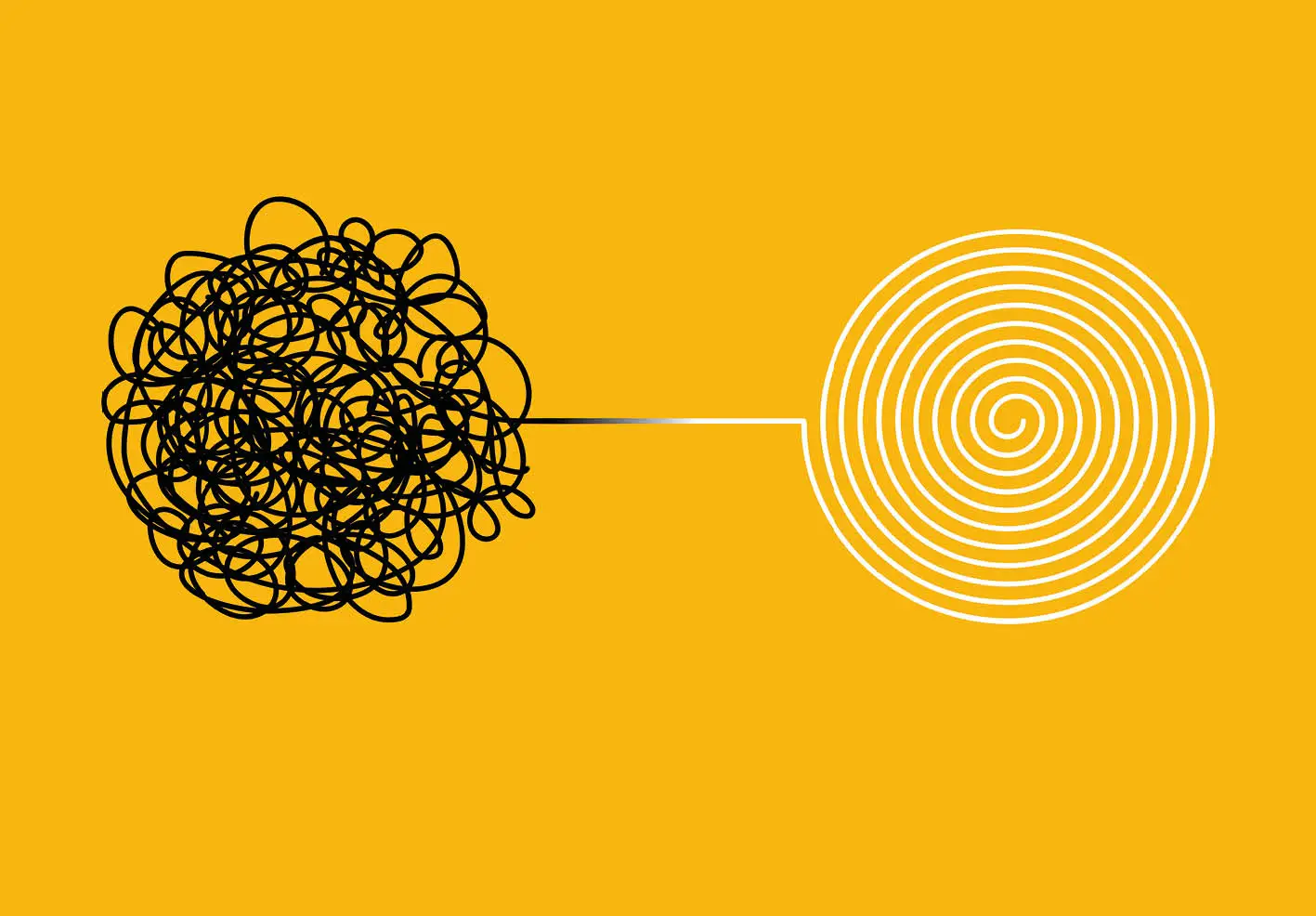
Those are big questions that can feel overwhelming, and a typical reaction to big questions like these is to retreat into the familiar and just keep going on our treadmill. And that is what I am interested in. I am curious about how the clutter in our lives gets in our way, in the way of the big stuff, and keeps us right where we are. Only once we see it all laid out, how it is interconnected, what habits we have developed, and what choices are available to us, can we consider ways of de-cluttering some of that stuff that keeps us stuck where we are.
Alongside the number of hours in the day, the other finite resource we have is our mental capacity
Clutter? What does that mean? And how does it have anything to do with driving a sustainability agenda as a leader?
We go through life accumulating all manner of stuff. Some of that will be physical stuff. That is the obvious, tangible, and most visible manifestation of this accumulation. But alongside all the stuff we can see is also less visible stuff: there are our thoughts, our habits, our inner chatter, our feelings, our emotions, our beliefs… Then, there is also the broader context and the organizational stories and beliefs, habits and assumptions…
In my work studying clutter and its effects on people and businesses, I identified several different types of clutter. Each type impacts us differently, but they are all interconnected and together, they contribute to making us feel stressed and overwhelmed. We will take a look at a few of these types of clutter shortly.
But before we get stuck in a bit more detail, I do want to make one thing clear though. Clutter in itself is not a bad thing, far from it! Who would we be without our inner world of thoughts, feelings, and emotions, or the items that make up our ideal work environments or our homely cozy spaces? And many of the habits that we have developed over our lifetime are very useful to us.
Clutter does need our attention, however, when it gets in our way, it stops us or those around us from doing the big stuff, both at work and at home. That is when we need to take a closer look and step into action.
Now let’s turn our focus back to our sustainability agenda. What types of clutter could get in your way of delivering the changes needed at the pace required? If you observe your patterns and habits around this topic, what do you notice? Let’s take a look at what might trip us up.
The first and probably most obvious area to look at is our diaries, and that of our team(s). The likelihood is that most of our hours are already filled one way or another. We are busy, the world is busy, work is busy. So if we want to start doing something new (like thinking sustainably), we need to stop doing something else, at least for a while.
But so often, we are asked to deliver ever more, without the recognition that something else will have to give. Does this sound familiar?
Just like budgets running out, our resources are also limited and will become depleted. So of course we might look at what drains us versus what energizes us, and plan to build in those activities that will nourish us. But in the end, there are only so many hours in the day, and only so much that we can achieve. Unless sustainability is given sufficient time in calendars, it will not happen. How much time are you ring-fencing to focus on this in your organization and team, and is it enough?
Alongside the number of hours in the day, the other finite resource we have is our mental capacity. As increasingly more media stories report on all manner of topics related to climate change, the health of the planet, large-scale migration, rising inequality, the dying of the oceans, micro-plastic pollution, and a host of other big macro-problems, what do you notice is your mental chatter around these stories? Do you give them much air-time in your mind? Is your brain at capacity with everything else you are dealing with at the moment? Or does it all feel too overwhelming to consider without falling into despair?
And how about your employees, how much mental clutter are they carrying these days and how much mental capacity do they have for a change of any kind?
Our resources are finite. Just like there are only so many hours in the day, we also have only a finite amount of brain processing power in our pre-frontal cortex.
The pre-frontal cortex is located at the front of the brain, and it is the part of the brain that carries out the executive function, meaning that this is the part of the brain where all our daytime processing takes place. It is where we take in information and make decisions based on goals, preferences, and judgments on whether something is good or bad, where we work out the consequences of our actions. This is essentially the machine room that allows us to function, and which drives our actions.
And this part of the brain, this pre-frontal cortex, can only handle so many processes at any one time. Even if it is quite impressive in its abilities, it is nonetheless limited, resetting itself and cleansing its memory whilst we sleep (so yes, looking at what clutter might get in the way of us getting a good night’s sleep is also useful).
Our emotions are a part of us and we carry them with us in everything that we do. They are what makes us human, and in the age of the rise of AI, we might want to hold onto those as much as possible!
In our age of information overload, stimulus overload, out-of-control inboxes, addiction-inducing distracting communication and social media platforms - our digital clutter - as well as a general sense of never quite being on top of things, simply dealing with our day-to-day lives creates so much mental noise that makes it difficult to stay focused on any one activity or task for any length of time.
To implement anything new requires energy, we cannot keep piling change upon change and objective after objective and expect individuals to perform well if we do not first de-clutter and create some space for this new stuff. And so it is also for any sustainability agenda.
We need to clear some mental clutter to create head space for the thinking around the change that needs to happen to truly embed sustainability. Are you, your team, and the rest of the organization in a place where you can do this properly? What unhelpful mental clutter will you put aside to make this a success?
Finally, another area of clutter that gets in the way of us focusing on and implementing our sustainability agenda is our emotional clutter. Our emotions are a part of us and we carry them with us in everything that we do. They are what makes us human, and in the age of the rise of AI, we might want to hold onto those as much as possible!
So let’s identify what emotions we might be holding around sustainability and consider how we might put them to good use.
Quite often when I speak with leaders, they seem conflicted and uncertain about what they feel. On some level, there is the above-mentioned despair and overwhelm, but on another level, there is also optimism and hope. The key is to find a way to hold all these different emotions simultaneously, simply acknowledging that they are there and knowing that they will be fluid. The same will hold for everyone else around us too, and unless we pay attention to what others will feel at a particular point in time, we will fail to connect with and engage them as well as we might.
Yes, it might feel awkward to start talking about our emotions at work. But equally, if we cannot align our emotions with whatever we are trying to do, we will not be as successful as we could be, and it will all feel like an incredible struggle. So find a way to talk to your team about emotions, yours and theirs, about the topic of sustainability, and you might be surprised at what you find out.
We have now covered a few different types of clutter (in our diaries, in our minds, digital, our emotions - there are more!), and highlighted some that might get in our way. What do we do about it all?
Step 1: We call the clutter out for what it is. We pay attention to all the stuff that holds us back, keeps us stuck in what we have always done, and keeps us safe from the unknown and from the difficult balance between doing what is right for the business as well as for the planet. We carry out an honest audit of how our personal and organizational clutter creates barriers to the delivery of our green agenda, and we identify what is required to overcome them.
Step 2: Once we know what clutter is in our way, we put together a plan of how we de-clutter some of the stuff that is in our way. As with all good plans, we make this one as clear, measurable, and achievable as possible.
Step 3: We get started on delivering the plan. Right now. Of course, we might get derailed as other business imperatives creep up and take over. But we return to our plan and continue to carry out our tasks one after the other.
Sound too easy? Everything does not always have to be hard because we expect it to be. The key is to step back and create some thinking time to hatch the right plan, as well as use all the talent around us because we do not have to come up with everything ourselves. So what will you do today to create space for sustainability in your diary, mind, and heart? Because if you don’t, who will?