






This Idea can be purchased for personal use only here
Leadership is one of those fields where the advice never seems to run out. Business schools, consultants and executive coaches have produced enough models, competency lists and to-do inventories to fill several libraries. Most of them are not wrong, exactly. They just tend to miss the point.
The reason is perhaps deceptively simple. Most leadership models focus on what leaders do how they communicate, how they set objectives, how they build trust. But people do not respond primarily to behaviours. As Maya Angelou is often misquoted as having wryly observed, we respond to how others make us feel. And the feeling that matters most, the one that sits at the root of engagement, discretionary effort and genuine performance, is not satisfaction, or alignment, or even purpose. It is relevance.
The feeling that matters most, the one that sits at the root of engagement, discretionary effort and genuine performance, is not satisfaction, or alignment, or even purpose. It is relevance.
Not importance. Not recognition. Relevance: the quiet, internal sense that one matters here, that one's presence has impact and one's work genuinely counts.
This is the animating insight behind what we are calling Relevance-Centred Leadership (RCL). It is not a new model; we do not need any more of those, and as George Box noted, while models can be useful, they are always wrong. But it is a new framework and perspective on the growing body of Human-Centred Leadership thinking; a clarification and amplification of what has always been true about human beings in organizations: that culture is not built at the organizational level. It is the accumulated expression of individual psychological states. And when those states tip toward irrelevance, toward the feeling of being unseen, unnecessary, interchangeable, organizations pay a steep price, whether in burnout, disengagement, defensive culture, or plain underperformance.
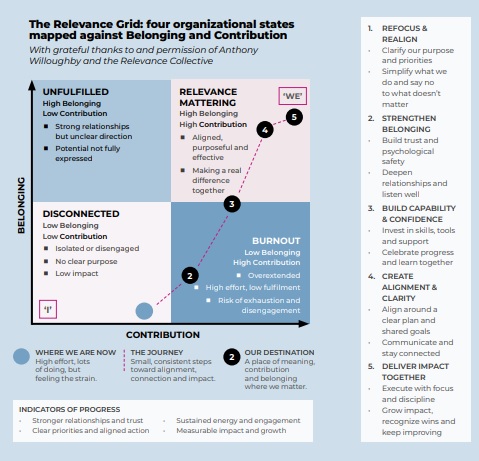
A useful way to visualize this is through what we call the Relevance Grid. It plots organizational experience across two axes: Belonging, the degree to which people feel connected, trusted, and part of something, and Contribution, the degree to which they feel they are making a meaningful difference. The four quadrants that result are most probably uncomfortably familiar to most leaders.
Low belonging and low contribution produce the Disconnected state: isolated, purposeless, low-impact. High contribution without belonging produces Burnout: overextended, high effort, low fulfilment, and at serious risk of disengagement. High belonging without contribution produces the Unfulfilled state: strong relationships, unclear direction, potential that never quite surfaces. And high belonging with high contribution is where organizations and people thrive: the state of Relevance and Mattering, aligned, purposeful, making a real difference together.
What the Grid also shows is a possible journey a dotted path that winds from, in this instance, the Burnout quadrant upward and across towards Relevance and Mattering. It is not a single leap. It is a series of small, consistent steps which strengthen belonging, build capability and confidence, create alignment and clarity, and ultimately deliver impact together. The five-stage pathway on the right of the Grid gives that journey practical shape. Most organizations, if they are honest, will be able to identify exactly where on that path they are currently sitting.
The Emotional Architecture of Relevance
The Relevance Framework maps ten psychological transitions, each describing a movement from a contracted, threatened state to one of expansion and engagement. Feeling:
• 'Unnecessary' becomes 'contribution'
• 'Isolation' becomes 'belonging'
• 'Confusion' becomes 'clarity'
• 'Anxiety' becomes 'confidence'
• 'Emptiness' becomes 'purpose'
• 'Helplessness' becomes 'agency'
• 'Apathy' becomes 'curiosity'
• 'Fear of failure' becomes 'courage'
• 'Loneliness' becomes 'connection'
• 'Despair' becomes 'hope'.
What is striking about this list is that it is not a set of theories. Leaders will most likely recognize each pairing from direct experience: the team member of staff who stopped contributing not from lack of ability but from a creeping sense that their contribution did not matter; the team that went quiet not from disengagement but from confusion about where they stood. These are not edge cases. They are the texture of organizational life.
The greatest impact of these transitions is in the three outcomes organizations most want to build - psychological safety, empathy, and high performance.
The framework makes three practical claims about these states. First, they are universal: the same transitions are at work in a hospital ward in Newcastle, a trading floor in Madrid, or a start-up in Nairobi. Second, they are developmental; they build on each other in a recognizable sequence, much as belonging must precede contribution before autonomy becomes meaningful. And third, they are measurable and therefore actionable. This distinguishes them from the warm language of values that rarely survives contact with the real world of work.
The greatest impact of these transitions is in the three outcomes organizations most want to build. Psychological safety emerges when people experience belonging, clarity and confidence. Empathy becomes operational when people feel genuinely seen and understood. High performance follows when people experience contribution, agency and hope. Relevance, all of a sudden, is not a nice-to-have. It is the foundation on which everything else depends.
The Missing Link
Leadership development has long struggled with its difficulty in proving its return on investment: we know what good leadership looks like, and yet consistently good leaders remain rare. Part of the explanation lies in what the German psychologist Hermann Ebbinghaus identified in the 1880s: his 'forgetting curve' has shackled every training programme since. 80% of what is taught in a programme is forgotten within a couple of weeks; action and on-the-job learning go some way to manage that. But there is a more structural problem too.
Much of the advice given to leaders build trust, empower others, create psychological safety describes outcomes, not mechanisms. Trust, for instance, is a 'gift word': it is something bestowed on you by others, not something you can acquire directly. Telling someone to build trust is a little like telling them to grow a garden. The ambition is sound; the instruction is incomplete. Trust and the garden share the same requirement: all the leader and the gardener can do is create the conditions for the outcome to flourish. The gardener cannot make the flowers bloom, but without her attention, nothing else will.
Leaders need to stop trying to fix culture as though it were a system error, and start attending to the human conditions from which culture is actually made.
Relevance-centred leadership sidesteps this problem by focusing on what leaders can actually do: the specific behaviours and micro-conditions that shift people's psychological states from contraction to expansion. It is not a different destination. It is simply a more reliable road to the same one.
The corollary is equally important. Organizational culture does not change from the top down in any meaningful sense. It changes when enough individual psychological states shift, when enough people move, one by one, from irrelevance to relevance. Leaders need to stop trying to fix culture as though it were a system error, and start attending to the human conditions from which culture is actually made.

Seeing the Person
The first of the ten transitions from feeling unnecessary to contribution reveals something counterintuitive. Relevance does not begin with meaningful work. It begins with recognition. People need to feel seen before they are able to contribute, and the absence of that recognition is one of the most quietly corrosive forces in organizational life.
The difference in practice is small but significant. It is the difference between 'I need that report' and 'How are you getting on with that report, is there anything you need to help you with it?' It is the difference between treating someone as a function and treating them as a person with pressures, strengths and potential. These are not sentimental distinctions. Social acknowledgement activates reward pathways and suppresses threat responses. Recognition is neurological before it is managerial. Human-centred leadership begins with the smallest of gestures. And those gestures, compounded across a team and over time, build something that no strategy document or culture initiative can.
The Structure of Safety
One of the less celebrated drivers of psychological safety is predictability. When people cannot predict what will happen next in their relationships with their manager, in their understanding of priorities, in the reliability of communication, they experience exactly the confusion, anxiety and withdrawal that the Relevance Framework identifies as precursors to disengagement.
Predictable rhythms a consistent weekly check-in, a clear meeting structure, the habit of closing the loop reduce cognitive load and create the conditions in which people can attend to their work rather than scanning for threats. This is not rigidity. It is reliability. And it is empathy expressed in a predictable routine: the understanding that uncertainty is itself a stressor, and that removing it is a leadership act.
The same logic applies to the 'why'. Leaders who explain the rationale behind decisions before issuing instructions are doing something more than good communication. They are addressing the human need to make sense of action through meaning. Without context, work feels transactional. With it, work feels purposeful, and the difference in performance is not marginal.
Effort, Agency and the Psychology of Growth
Relevance is not only about outcomes. It is about effort. When effort goes unacknowledged, that is when the process of working hard is invisible to those above and around us; people experience anxiety, self-doubt, and eventually the helplessness of being ignored or overlooked that can be utterly demoralizing. Acknowledging effort is not weakness or lowering the bar; it is often the opposite. It is recognizing that excellence is a process, and that people are valued for who they are becoming through their work, not only for what they currently produce.

The related transition from helplessness to agency may be the most consequential of all. Agency is the psychological foundation of ownership, initiative, and innovation. It is the belief that one's actions can change outcomes. When it is present, people take risks, persist through difficulty, and shape their environment creatively. When it is absent, they retreat into compliance or quiet resistance. The research on this is substantial and unambiguous: reducing people's sense of control, even implicitly, even inadvertently,tly extracts a measurable cost from their engagement and output.
Reducing people's sense of control even implicitly, even inadvertently extracts a measurable cost from their engagement and output.
The practical implication lies at the core of leadership: judging the risk of giving permission to someone to take more autonomy. It is the leader's job to assess how much responsibility can safely be devolved, and then to devolve it explicitly. Agency is granted by explicitly granting permission, and cultivated by giving people decision-making power over things that genuinely matter, and then trusting them to exercise it. This is a human behaviour that we have been practicing for millennia.
In the Maasai tradition, they give very young children goats to look after; goats are valuable, and the community relies on them. So the three Rs of psychological leverage are activated: Responsibility (the task is real, not symbolic); Reciprocity (the community relies on the child to do the work, and the child relies on the community for its wellbeing); and so Relevance (the child is trusted with something the community needs). In Western organizations trying to find something similar can be trickier, but giving an intern responsibility for a regular weekly meeting or newsletter, or management of a content library could create similar activations of these three Rs at a junior level.
Empathy as Practice
Empathy is often framed as a trait, something leaders either have or lack. The Relevance Framework reframes it as a practice, expressed through specific micro-behaviours: noticing when someone withdraws; naming emotions without judgement; creating small moments of connection; correcting privately and celebrating publicly; making reasoning visible; reducing unnecessary friction; giving people a narrative about their future in the organization. None of these requires exceptional emotional intelligence. They require attention. And they communicate, consistently and cumulatively, the message that matters most: you matter here, I see you, you belong. Relevance is the psychological outcome of sustained empathic practice, and performance follows from relevance.
The Relevance Arc
Belonging before contribution. Contribution before autonomy. The sequence is not arbitrary; it mirrors both human development and organizational development. A child needs belonging before they are ready to contribute. An adolescent needs contribution before they are ready for genuine agency. An adult needs autonomy to reach their full potential. The same arc applies to teams and organizations: psychological safety before performance, performance before innovation, innovation before the kind of adaptive capacity that allows an organization to evolve.

Look again at the Relevance Grid and the journey mapped across it. The five-stage pathway Refocus and Realign, Strengthen Belonging, Build Capability and Confidence, Create Alignment and Clarity, Deliver Impact Together is precisely this arc made operational. It is not a linear checklist. Leaders must continually rebuild belonging as teams change, reinforce contribution as roles evolve, and expand autonomy as capability grows. The arc is not a destination. It is an ongoing orientation.
Leaders must continually rebuild belonging as teams change, reinforce contribution as roles evolve, and expand autonomy as capability grows.
Why This Outperforms
Traditional leadership models, broadly speaking, assume that performance drives engagement. The Relevance Framework reverses the causality: engagement drives performance, and relevance drives engagement. Belonging increases trust and collaboration. Contribution increases motivation and the discretionary effort that lies beyond the minimum required. Autonomy increases innovation and ownership. Hope, perhaps the most undervalued of the ten states, increases resilience and the capacity to sustain effort through difficulty.
These are not soft outcomes. They are the psychological conditions that enable hard ones. The Relevance Grid makes this visible in organizational terms: the high-belonging, high-contribution quadrant is not just a nicer place to work. It is where sustained performance, innovation and adaptability actually live. Organizations in the Burnout or Disconnected quadrants are not simply underperforming; they are running on borrowed time. And relevance-centred leadership outperforms its alternatives not because it is kinder, though it often is, but because it aligns with how human beings actually function.
It treats people as humans first and performers second, and in doing so, consistently unlocks performance that purely transactional leadership simply cannot reach.
A Final Thought
Leadership is ultimately not about the leader. It is about the conditions leaders create and the states those conditions produce in the people around them. When organizations thrive, it is rarely because of a brilliant strategy or a charismatic figurehead. It is because enough people, in enough moments, felt that what they were doing mattered and that they mattered too.
The Relevance Grid gives that ambition a shape. The dotted journey from Burnout to Relevance and Mattering is not a smooth or inevitable i t requires deliberate, sustained attention to the human conditions from which performance is made. But it is a journey that any leader can begin, with any team, on any given morning.
Relevance-centred leadership does not offer a new philosophy. It offers a more precise and actionable account of what good leaders have always done intuitively: given people a reason to care, and the conditions in which caring is possible. The evidence for why this works is substantial. The opportunity to put it into practice is available every working day.
This article draws on the work and thinking of Anthony Willoughby and the Relevance Collective, of which the author is a part. For more information and guidance, and interactive assessment and outcomes on where you sit on the Relevance Grid visit: https://14relevancequestions.netlify.app/