





The issue of how artificial intelligence will affect human work is one of the most popular, but perhaps the least well-understood, of any aspect of AI. The high visibility of this issue alone, along with other rational reasons for concern, makes it an issue that leaders need to address head-on. Surveys suggest that CEOs see AI as a transformative force for their organizations, and many say they plan to reduce headcount because of it. Yet many CEOs and HR leaders have not articulated clear views on what they believe will happen to their human employees as a result of AI, which employees will be most affected, and how they should be preparing for the transition.
For over a decade I have been researching and writing about the issue of how AI will affect work and human workers. Like anyone who pays close attention to this fast-changing technology, I have had a few changes in perspective over the years. I have gone from pessimistic to optimistic to guarded based on what I have read, what I have observed and studied in actual workplaces, and what I have seen and anticipated in terms of changes in AI technology.
From Pessimism to Optimism on the Future of Human Employment
What I have read from other authors has largely made me more pessimistic. When I began to study AI and work, I read several books (including Rise of the Robots and Humans Need Not Apply, both published in 2015) that were largely speculative and negative about the long-term prospects for human employment. They made me quite pessimistic about human job prospects in the face of AI advances. In addition, the Oxford Martin Institute study of The Future of Employment was published in 2013, and it appeared to be rigorous in its methodology breaking jobs down into tasks and analyzing whether the tasks could be done by smart machines. It posited that 47% of US jobs were at risk of elimination from AI-driven automation, and received much publicity for its findings.
I have gone from pessimistic to optimistic to guarded based on what I have read, what I have observed and studied in actual workplaces, and what I have seen and anticipate in terms of changes in AI technology
But then Julia Kirby and I decided to write a Harvard Business Review article (nicely illustrated with photos of toy robots) and a book on the subject. We began to interview managers and professionals about what they and their organizations were actually doing with and planning for AI. In that research, we found very little evidence of large-scale automation and job elimination. We realized that most jobs consisted of many tasks, and only some of them could be automated with AI. Only in structured manufacturing environments, where each new robot displaces 3.3 human workers on average, has there been substantial job loss. Indeed, many companies have found it very difficult to hire the workers they need over the past several years.
When Kirby and I published a book about our findings in 2016, instead of suggesting that no humans need to apply for work, we titled it Only Humans Need to Apply. We argued that the “augmentation” of humans and machines working in combination was both more likely and a better strategy for organizations in thinking about AI and work. It gives organizations more flexibility and ability to innovate, while still taking advantage of the speed and efficiency advantages of some automation. We discussed five different steps that humans can take to augment AI, the most common being for humans to “step in” and work directly in collaboration with AI. I believed this to be an optimistic perspective and held it for several years; nothing I observed in talking with many organizations made me feel that large-scale automation was on the immediate horizon.
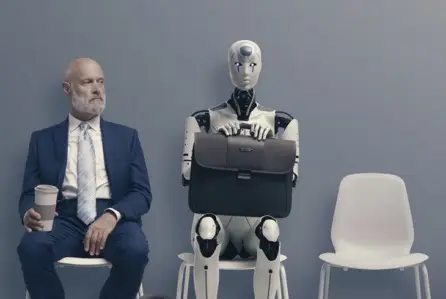
Only in structured manufacturing environments, where each new robot displaces 3.3 human workers on average, has there been substantial job loss
I was further confirmed in this optimistic perspective a few years later, when I published a book in 2022 with Steven Miller called Working with AI: Real Stories of Human-Machine Collaboration. We felt that if people were going to be working alongside AI, they might benefit from some detailed examples of how that collaboration works out across multiple different work settings. The resulting book included 29 short case studies of how humans and machines were collaborating on a daily basis. Almost all of them with the possible exception of an automated but unreliable hamburger flipper were working well for both employees and employers. Not a single incumbent of these 29 jobs expected that their role would be automated out of existence. In the discussion of the implications, we concluded, “We suspect that even with the relentless trajectory of improvement in AI capabilities, widespread augmentation is here to stay.”
Further contributing to my optimism on this topic was some research I compiled on predictions of how many human jobs would be lost or gained from AI. I reviewed nine predictions on the total number of jobs to be lost or gained and eight on the percentage of jobs that would be automated or automatable. The predictions varied widely, but they had several things in common. They all predicted substantial job losses (from 1,800,000 to two billion). They all provided a date by which the jobs lost or gained would be realized, varying from 2018 to 2038. Most also said there would be some job gains from AI, although most predicted substantially more losses than gains. All predicted some moderate-to-substantial percentage of automated jobs ranging from 5% to the aforementioned 47% from the Oxford study.
One other thing these predictions have in common is that they were all wrong some by massive amounts, some by smaller ones. The extent of their inaccuracy for predictions after 2024 (and before the present as well), has yet to be discovered, but I suspect they will be quite wrong as well. All predicted millions of jobs lost and some predicted millions of jobs gained, but there is no evidence that either has come to pass. There is no good data on how many jobs have been lost or gained because of AI, but there is also no evidence of large-scale job loss. In many industrialized countries around the world (the most likely to deploy AI), there is low unemployment and labor shortages in many professions. Fields that were described as being highly subject to automation radiology, for example, have particularly high levels of labor shortages.
The smart predictors revised their predictions over time largely becoming less pessimistic. The McKinsey Global Institute, for example, predicted in 2017 that 50% of job activities could be automated by 2055 or earlier. The same organization predicted in 2018 that 15% of global workers would lose their jobs to automation by 2030. In elaborations on these predictions, however, the consultants reduced the number of jobs likely to be automated out of existence to 5%, based on contextual factors like the technical feasibility of automation, the costs of developing and deploying automation solutions, and labor market dynamics. Even 5%, of course, has turned out to be an overly high prediction.
Generative AI and the Coming SWe should begin ingularity
Any good gambler tries to cover his bets, however, and my co-authors and I did so. In the Working with AI book, for example, the last section of the last chapter was titled, “If the Singularity Comes, All Bets Are Off.” Miller and I thought if “singularity” or “artificial general intelligence” (AGI) ever came about AI systems that could do everything that humans do, only better and faster it would be difficult for humans to compete in job markets. But we, like most other “experts,” felt that the singularity would not arrive for several more decades. Martin Ford, an “AI futurist” with a strong belief in automation-related job loss, interviewed 23 technical AI experts in the book Architects of Intelligence. 18 of the experts made predictions about when the singularity would take place. The average of the predictions was 2099.
One encouraging aspect of generative AI to date is that effective use of it should require a “human in the loop.”
Because of generative AI, I am guarded about when AGI will come and what it will mean for jobs. A 2024 survey of a larger number of AI experts found that 50% now believe that AGI will take place by 2040. Generative AI as we currently experience does not represent AGI, but it provides a strong hint of what superintelligent machines will be able to do in the relatively near future. It already can write, converse, or create images better than many humans, and it is still early days for the technology.

Content creators like the Hollywood writers who went on strike in 2023 in part to keep generative AI out of their jobs have a lot to fear from it. Call center agents, actors, commercial artists, entry-level lawyers, and many other job incumbents are also involved.
Despite these concerns, early concerns about generative AI quickly displacing large numbers of workers have begun to fade. For example, several journalistic organizations (including CNET and Sports Illustrated) that embraced the technology early on found that it made highly visible errors and antagonized human employees, and they backed away from broad use of it. And generative AI use does not seem to have increased productivity measurably thus far.
One encouraging aspect of generative AI to date is that effective use of it should require a “human in the loop.” Given the possibility of hallucinations (really just bad predictions by these statistically-based models), it is important for humans to review the output of gen AI models to ensure accuracy. In addition, users of generative AI often need to add value to the generated content to ensure that it is interesting and useful as well as accurate. Given that Gen AI is trained on existing online content, it is unlikely that outputs will be truly novel. That may be fine for some applications, but content creators need to realize when it is important to go beyond well-established ideas and formats. However, reviewing and editing generative AI output may not be a natural inclination for human users. In one study of knowledge work creation by MIT researchers, 68% of participants chose not to edit the output of a language model. Although it is still early days for the technology, generative AI has not changed the employment situation much yet in large organizations. Many of the companies I speak with that are adopting generative AI for various use cases still say at least for public consumption that they are augmenting human labor with the technology, rather than eliminating it. The line usually goes, “We’re freeing up humans to perform the tasks that only humans can do,” or something along those lines. That has been the consistent party line for many years now, and the low unemployment numbers in the U.S. would seem to support it. A few organizations, such as Klarna in Sweden, have stated that generative AI will lead to substantially lower employment in some jobs (customer service in their case), but they are evolving to it through attrition.
With other new technologies, history has been on the side of human workers. Previous technologies that threatened jobs such as ATMs and Internet banking with regard to bank tellers did not decrease the number of teller jobs but only slowed their growth. In jobs like newspaper reporting, although having AI write stories penetrated the industry a decade ago (particularly at the Associated Press, which recently struck a deal with OpenAI to collaborate on generative AI-written stories), the decline of newspaper advertising was a bigger factor in job loss. Generative AI may speed up the decline of this and other waning professions, but I doubt it will be dramatic.
What we will see happen quickly, however, is that many jobs will involve working with AI as a collaborator or, as it is frequently called today, a “copilot.” I have long believed that the only people who will lose their jobs to AI in the near term will be those jobholders who refuse to work with AI. They will be left behind as AI makes human workers in many jobs more productive and effective. Those who work alongside AI will have to adopt new skills and behaviors, but as long as they are flexible they are likely to remain employed.

What Should Leaders Do?
Generative AI portends a scarier future, and the time is now for leaders to begin to speak and act about that future. The transformation of work by AI will, I believe, be more gradual than dramatic, but it will also take years for organizations and employees to fully prepare themselves.
There are several key steps that they can take today.
One step for social and political leaders is to help threatened workers prepare themselves for the future. Over the long-term successor versions of the already-impressive generative AI tools we have today are likely to hasten the pace of job loss. We should begin to prepare now for providing humans with money to live on and something useful to do when there are no longer enough jobs that only humans can do well.
We should begin to prepare now for providing humans with money to live on and something useful to do when there are no longer enough jobs that only humans can do well.
Business leaders need to realize and communicate that business processes and tasks with “a human in the loop” are more likely to be successful than those that are fully automated. With generative AI, they need to encourage critical thinking and human review of AI output. Announcing that augmentation—not large-scale automation will be the primary approach to AI will address workers’ fears and give them the confidence to embrace AI in their own jobs.

Practically everyone within organizations will benefit from learning about how AI works and what its strengths and vulnerabilities are. This will help us all to become an effective colleague to AI systems. High-quality education on AI will be targeted to specific business functions and, in some cases, even jobs. Some companies, like Rack Space, have already trained every worker on AI. Some states, including California, are embarking upon large-scale worker training on AI as well. Organizational leaders should also address what types of jobs will become collaborative with AI, and in what ways. There are at least nine different options for how humans and smart machines can work together. In some cases, for example, the human takes the first pass at a task and the machine reviews it; in others, the human has the last word. Begin to think about which options are most appropriate for key roles, and to train people in them for the relevant type of collaboration. Finally, the question of how AI will affect a large organization’s workforce is a complex and multi-faceted one that no individual leader can resolve alone. Executives should therefore put a group together to address the issue, with leaders of HR, AI, and some aspects of operations. Front-line workers or (where they exist) unions should also be involved. The group should determine who will be impacted in what ways, how to prepare for the changes, and what organizational structures should be responsible for the transition.