





Large Language Models. Retrieval Augmented Generation. Computer Vision. Generative AI. Prompt Engineering. Maybe you know those words. Most people don’t. But with the advent of the popular ChatGPT chatbot and the incredible pace of advancement in the field of artificial intelligence, those words are becoming essential vocabulary for leaders of organizations large and small.
And for all the so-called “hallucinations” of chatbots like Gemini or Claude or ChatGPT that we hear about, AI expert Ian Beecroft said that these models are improving at the extraordinary rate of 5 to 10 times per year, which is problematic for leaders.
“The challenge,” Beacraft said during his SXSW 2024 presentation, “is we’re now in a cycle where things are moving exponentially. So just doing a discrete session of business transformation isn’t enough because by the time you finish, you’re already behind again. We’re now in an era where regeneration, constant regeneration is necessary, not just one moment of transformation.”
As a result, leaders are bewildered by this hypercharge. According to a recent BCG study, 66% of executives surveyed are “ambivalent or outright dissatisfied with their organization’s progress on AI and generative AI so far.”
“The challenge is we’re now in a cycle where things are moving exponentially. So just doing a discrete session of business transformation isn’t enough because, by the time you finish, you’re already behind again.”
Some are taking action, but most are still in consideration mode. The same survey showed that 90% of executives surveyed are “either waiting for GenAI to move beyond the hype or experimenting in small ways.” That report suggests that these companies are “observers… opting for a wait-and-see approach. That’s not an option with generative AI.”
Why are so many leaders stuck in analysis paralysis? To be fair, caution is a common human response in the face of such sudden change and uncertainty. According to this 2024 survey of leaders and machine learning experts, there are many reasons why AI is not the number one focus of many organizations.
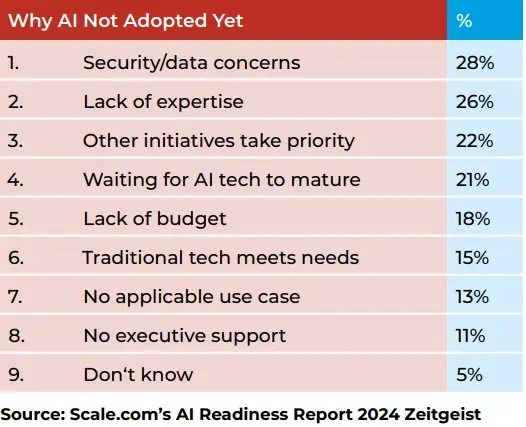
Leaders often cite legitimate concerns, for example, of employees pasting sensitive and confidential data into a chatbot, the lack of AI expertise in their organizations, or the fact that their current processes are more of a match for their traditional tech, and would not align easily to AI systems. They need more time to understand AI and how to implement it safely and effectively, they say.

But the reality is, that the longer leaders wait, the more their organizations fall behind. Leaders know what BCG has uncovered in its 2024 survey of over 1,400 executives: they have a “lack of AI talent and skills,” an “unclear AI and GenAi roadmap and investment priorities,” and have “no strategy for responsible AI and Gen AI.”
Many are genuinely worried because not only is their organizational AI acumen low, but nearly 60% of leaders surveyed by BCG say they have limited or no confidence in their executive team’s proficiency in GenAI. This is a shame because it isn’t all that expensive or difficult to implement AI tools or processes.
It is certainly easy and inexpensive to learn quickly. Leaders need to make time to read, watch, and participate in the ample books, articles, videos, online courses, conferences, and face-to-face training courses available.
Leaders need to understand how AI is being applied today, to reflect on how AI can impact their company direction and strategy.
University executive education also has a huge role to play here. There are three powerful ways to leverage executive education to drive AI activation in organizations:
• Create Time for Leaders to Understand, Reflect, and Plan: Leaders need time to reflect on how to handle this period of uncertainty. Leaders need to understand how AI is being applied today, to reflect on how AI can impact their company direction and strategy, as well as to reflect on the ways to break through the walls of uncertainty and take decisive action. Leaders also need time to know when AI is not the answer, the design of effective processes before or instead of AI implementation is a greater need. Many university flagship leadership programs put AI front and center in a curriculum designed to slow down one’s thinking in consideration of what it takes to go from the current to the desired state, and when and when not to apply AI.
• Accelerate Development and Performance of Hi-Pos: Leaders need to leverage their high-performers, who are commonly their AI champions and driving higher EBIT than the rest of the organization, according to a 2022 McKinsey report. This is an opportunity for leaders to work with external providers to design a hi-po-leadership development program that leverages their extant AI acumen to focus on the company’s thorniest issues or strategic initiatives.
• Build Organizational AI Literacy: Many organizations have discouraged employees from using AI tools due to concerns about data and privacy. Measures need to be taken so that organizations do not force employees to use GenAI in the shadows and keep their tips and tricks a secret. You want to grow AI literacy throughout the organization. Leveraging the most generally available AI tool, the large language model, and providing training in critical thinking skills can go a long way in leveraging the true analytical and creative powers of these chatbots.


