

Purchase this article as a standalone PDF with full colour magazine layout
Introduction
What is coaching really about? It is a confidential process between a client and a coach to achieve one or more specific objectives through challenging questioning. This confidentiality can make it opaque and somewhat mysterious to those who have not experienced it, so in this article, I present, in very short form, some stories from my own diverse experiences. I hope they illustrate typical situations that executive coaches find themselves assisting with. But first, let me tell you where my own coaching journey started.
Can you imagine?
Twenty-seven years ago, after my return from Asia, Iain Martin, my co-founder of what is now our executive coaching business, and I asked ourselves: “Can you imagine how much better the world would be with excellent leadership? Can you imagine how much better business would perform if all leaders were the best that they could be?” Our questions were inspired by our own experiences of working under some good leaders, but also many horrible bosses, and oh, how many sleepless nights did they cause, and at what cost to the Bottom Line! The answers to our questions were compelling.
With that vision in mind, our mission became “to help grow the business bottom line through excellent leadership”. Executive coaching, hardly known then and a greatly overused term now, was the most impactful way to realize our mission. Good executive coaching addresses both the hard business KPIs and the “soft” people factors. Its effects disseminate throughout an organization and beyond.

But why would someone embark on a coaching programme? Board members, CEOs, and C-Suite executives lead lonely lives. A business-hardened coach acts as pacemaker, quiet listener, skills facilitator, challenging debater, comfort creator, but also a generator of discomfort.
Developing people shows that the company cares. But it also costs far less than firing and replacement, not only in demonstrating loyalty and avoiding high search fees but also in retaining inside knowledge, business experience, and customer-colleague relationships.
And why would a corporation pay a sizeable fee for someone to be coached? The answer goes beyond growing people and fixing problems. Developing people shows that the company cares. But it also costs far less than firing and replacement, not only in demonstrating loyalty and avoiding high search fees but also in retaining inside knowledge, business experience, and customer-colleague relationships. It is the best and cheapest way to build your top Talent Pipeline. Moreover, excellent leadership becomes a Virtuous Circle, penetrating all the way through the organization. Helping leaders is essentially a means to achieve a bigger purpose: to improve stakeholder returns through excellent leadership. Therefore, coaching is really a business investment with potentially high ROI, and not an overhead cost. Good coaching helps the individual being coached, but should also deliver a significant ROI bonus to the business’s bottom line. The different scenarios below demonstrate that important point.
The $500 million question
Michael, a respected regional president in a US corporation, told his coach: “I’m bored. I’ve done it all. I want to retire soon, so I need help to start my board career.” “I can do that”, said his coach, “but what would make you stay in the company? What do you know that others here don’t? What do others know that you don’t? How about a plan to harness all that? What would be the impact on the company’s bottom line and on your pension?"
That last remark was persuasive. Michael and his coach explored an initiative that the company needed, though did not yet know it. Because there was no way to share operational knowledge across this global corporation, expensive mistakes were repeated in many manufacturing and business territories. Michael and his coach together identified a new role called Global Operational Excellence. Michael then devised a plan to spread best practice and expert knowledge throughout the corporation. He delivered annual bottom-line savings of US$500 million and later retired fulfilled and with a very nice pension.
Learning: By asking key questions addressing Michael's assumptions and frustrations, the coach helped him find new fulfilment and create huge cost savings. This story illustrates the interplay of soft and hard factors in coaching. It also underlines the importance of the coach having solid business experience to ask the right questions.
Key questions that can change everything
Asking key questions is an essential tool for a coach. In a recent coaching meeting where the client was talking about a potential senior leadership opportunity, she shared her concern: “But I’m a Functions Person.” Her coach replied, “Why are you putting that label on yourself? How much is this restricting your ambitions? Why should the past dictate your future?” She has applied for the role and has been shortlisted for this important line leadership job.

In our 360° feedback process, interviewing is another powerful coaching tool, where key questions can make all the difference between a shallow response from the interviewees based on their perceptions and one coming from deeper thinking. Live dialogue between coach and interviewees, not computerized multiple-choice questionnaires, is much better.
During an interview, our coach often asks the interviewee: “Why did you say that?”. Further questions make the interviewee think deeper. On replying to, “How could our client get better feedback from you?”, the interviewee is contributing to an action plan. By asking, “What can you do to change the situation?”, the coach is encouraging the interviewee to adapt their own behaviour and play an active part in the change.
The power of key questions is highly effective for eliciting feedback; both hard business factors and soft issues can be addressed together with a few key questions.
Bridging the Atlantic with a clearer understanding
Hilda, the client, was an overtly ambitious European business leader. Her frequent displays of ambition in meetings annoyed John, a USA-based colleague. The resultant friction affected the business and relationships between the two teams.
In the feedback interview with the US colleague, the coach asked: “What would you say if I said that Hilda thinks that you are very good at your job? She wishes that you could collaborate better.” The interviewee was astonished and started to rethink. He was then open to helping Hilda be less aggressively ambitious.

Back in Europe, the coach said to Hilda: “What would you say if I told you that John greatly values your work? He only wishes that you didn’t wear your ambition on your sleeve at every meeting.” Hilda was pleasantly surprised. The coach asked her to select three key feedback points about her meeting conduct and to ask John to discuss her performance after every meeting. John agreed to do that, thus becoming part of the success story. John and Hilda will never be friends, but they now have an effective and collaborative relationship from which both the global business and the teams benefit.
Learning: You do not need to love each other to collaborate effectively. The coach built a bridge by highlighting positive feelings as well as criticisms. While recognizing an improvement area, he converted an enemy into a part of the development process.
The importance of Feedback
In a 360° feedback session for Chris, a leader in a global tech company, our coach interviewed Juan, one of the client executive’s subordinates. Juan was a seasoned LATAM executive. Once trust was established, Juan raised some issues of concern to her: “Chris doesn’t know what’s happening on the ground here. He never comes to visit.” Not only did the local team feel neglected, but key clients felt that they were not listened to by HQ.
The coach asked: “Have you ever invited him?” Juan had never thought to do that, but said it was a great idea, if only Chris would take the time. Thereby, Juan was taking responsibility for improving the relationship.
The coach then encouraged Juan to come up with some specific objectives for a visit by Chris. The dialogue resulted in a good action plan, but more importantly, Juan’s final comment, “That felt so good—like talking to a shrink,” showed that the interview process can act as a catharsis for the interviewee. Juan now felt that he was taken seriously and that Chris would be informed of his concerns in a safe and anonymous process. It was a motivation booster for him. The feedback helped Chris build a bridge to Juan, and they developed a much more trusting relationship.
Learning: Never assume that others know what you want. The coach inspired trust and from her own experiences was empathetic rather than sympathetic to Juan’s issues. He sensed this and so could be completely candid in his comments. This also showed that a personal feedback interview, unlike a multiple-choice computer-based questionnaire, can coach the interviewee as well as the coaching client, thereby multiplying the investment’s ROI.
Getting into the C-Suite - from manager to leader
Caroline was a regional manager in a global corporation. The CEO saw her potential and asked us to coach her.
Our feedback said that she was micro-managing, firefighting, always stressed, and overworked. She liked to be liked and could never say “no”. She had no vision and was a driver, not a leader. It affected her family life.
The coach helped her ‘get out of the hamster wheel’, take time to think, and see the bigger picture. She was also a PowerPoint slave, so the coach asked her: “How can you think big, when you’re always staring at a tiny screen?”
She eventually understood that thinking time is also legitimate working time. They designed a vision to inspire people. She learned different leadership styles for different situations. They worked on prioritization and delegation, empowering her people and building trust. This motivated them and helped them grow. It liberated her time to do new and bigger work in the CEO’s team and spend more time with the family.
Learning: Most leaders are made, not born. Leadership skills can be learned. Real leadership includes slowing down, reflecting, seeing the big picture and working via others.

A key question which won the battle but not the war
Michelle was an intelligent, extroverted senior executive whose strong personality inspired many but discomforted some people from less aggressive cultures. Therefore, her career move to an alien culture was ill-advised. Her business abilities and energy won a fast elevation to Deputy CEO. This, however, angered another powerful C-Suite colleague. This peer was also a major shareholder in this business.
Michelle wanted to hire a manager from her former corporation. Her peer strongly resisted the idea because she had her own pet candidate in mind. To end the showdown, Michelle’s coach asked her some key questions.
“Whose budget will pay for this recruitment? Whose business will rise or fall by it? Who will get the blame for its failure?” The answer was, of course, Michelle and not her peer. Michelle won the argument, and the man started his new job.
Immediately, a whispering campaign began against Michelle and her recruit. Eventually, Michelle was so undermined that she resigned from her role. Without her protection, the peer accused this dedicated man of unprofessional conduct, and he was terminated immediately.
Learning: Never underestimate the danger of corporate politics. The key questions won the battle but there were no winners of the war. Michelle eventually found a new role. The man is struggling to find a new job. The peer, as a major shareholder, lost a fortune when the share price went into steep decline.
Win-win is always desirable, but in business life, bad leadership behaviour can also result in lose-lose outcomes.
Real leadership includes slowing down, reflecting, seeing the big picture and working via others.
Coaching as a safety net
Coaching nearly always helps people, but it can also be an important safety net. Harry, a successful man, had never learned how to deal with failure. When he was fired from the CEO role that was above his ‘Peter’s Principle’ level, Harry was devastated. He asked us to help him.
One Friday afternoon, his coach became seriously concerned about Harry’s depressed mentality. Throughout that weekend, he spoke constantly with Harry to help him see a possible positive outcome.
Harry passed the crisis point without the need to involve a psychologist. His coach then helped him find his next role within his capabilities.
Learning: Coaching is a serious business with big responsibilities for coaches. While they often act as disturbers of complacency, they can be creators of comfort too.
Seeing beyond the obvious
Coaching should help people see possibilities that they alone cannot. Tom was the youngest and the smartest in the C-Suite. His CEO had just announced his retirement. The two probable candidates, long-serving executives who had no new ideas and no group vision, did not impress Tom.
“Have you considered yourself as a candidate?” asked the coach. “Not possible”, said Tom. “I’ve only been here two years.” The coach encouraged Tom to consider it, if only to make his mark for the future. Lacking CEO experience, he needed help just to get on the shortlist.
He agreed to an intensive coaching programme geared at creating CEOs. The coach posed a series of tough questions that the Nominations Committee might ask.
At the first interview, to everyone’s surprise, Tom topped the shortlist. After further role-play coaching, Tom impressed the NomCom and the board and was nominated. The coach then prepared him for the CEO role. Tom is now a strong and innovative leader.
Learning: Thinking beyond the obvious can have surprising results. Thorough preparation with a critical friend creates competitive advantage.
Coaching should help people see possibilities that they alone cannot.
Final thoughts
My tales are just a few from the broad spectrum of scenarios that we have dealt with over the years. Every case is different because people and situations are diverse and often complex.
Good leaders use techniques and business processes as valuable tools, but they overlay them with humanity, judgement, intuition and inspiration; and so do coaches. Leaders and coaches use tools founded in sciences, but they also use business and personal experiences, human connection, emotion, empathy, creative vision, spontaneity, flexibility, and storytelling, which add the artistic elements. Leaders and coaches, therefore, offer unique blends of art and science to achieve the same business outcome.
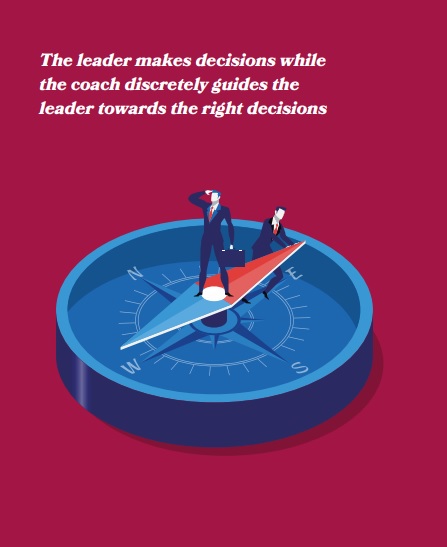
Executive coaches and leaders are almost inseparable. The difference is that the leader makes decisions while the coach discreetly guides the leader towards the right decisions. It follows that, if the leader sets out to grow the bottom line, then that must also be the coach’s end objective. So, what is executive coaching really about? I believe it is growing people, growing business, helping leaders become the best that they can be, and hopefully making the world a better place through excellent leadership.