

Purchase this article as a standalone PDF with full colour magazine layout
Traditional models of leadership development in organizations have largely relied on a download model: experts deliver content through lectures, e-learning, or video learning, and participants are expected to absorb and apply it.
Organizations have invested billions in these types of leadership programs with dubious results. Gallup this year reported that only 21% of employees worldwide are engaged in their work, a 2% decline since 2023.. McKinsey research finds that most leadership programs show no sustained impact on behaviour after 12 months unless there is on-the-job application and peer accountability.
Traditional leadership development is failing, but why? In his landmark book on the Nature of Managerial Work, Henry Mintzberg tells us that management and leadership are mostly a practice rather than a science or a profession. And Henry reminds us that, since it is mostly a practice, “management, like swimming, cannot be learned by reading about it.” In other words, teaching managers and leaders more stuff about managing and leading does not result in improved performance.
Most leadership programs show no sustained impact on behaviour after 12 months unless there is on-the-job application and peer accountability.
To develop the capacity to manage and lead, learners need to reflect. Henry Mintzberg adds the idea that the reflection on natural experiences needs to be in light of conceptual ideas. For example, reflecting on how you made your last decision at work while considering a model of managerial decision making.
Henry’s crucial insight was to realize that the mix of reflection on experience with content results in development. Melding a reflective approach, such as group coaching or action learning, with content gets the learners to re-frame their experiences and learn from them.
In practical terms, this is accomplished through the use of well-crafted guidebooks designed to drive peer-coaching group sessions. The guidebooks provide the crucial bits of content and the structure, enabling management and leadership development to occur. They are designed to guide the arc of each session to start with lots of reflection and introspection, and end with action, like a coaching session. They also enable a peer coaching group to run sessions without a facilitator, or with a participant facilitating, resulting in a highly scalable approach.
The International Coaching Federation (ICF) defines peer coaching as a collaborative-hierarchical relationship where two coaches support each other’s professional development by alternating roles as coach and client.
The International Coaching Federation (ICF) defines peer-coaching as a collaborative, non-hierarchical relationship where two coaches support each other’s professional development by alternating roles as coach and client. A peer coaching group is the same, except it is for a group of managers or leaders who support each other’s professional development by implicitly coaching each other.

The ICF defines coaching as partnering with clients in a thought-provoking and creative process that inspires them to maximize their personal and professional potential. In peer-coaching groups, the participants are peers, and they partner with each other in a similar thought-provoking and creative process, maintaining the spirit of coaching.
The idea for this approach emerged from a period of high pressure, high uncertainty, and low support in the early 2000s, born out of a need for a ‘better way’. Faced with budget cutbacks and ineffective traditional training, a small team of engineering managers, inspired by an international master’s program created by Mintzberg, began hosting short learning meetings guided by the content used in the master’s program. These were not lectures; they were structured dialogues around current work challenges, guided by thoughtful ideas and stimulating questions.
Originally, the approach was envisioned as ‘a learning meeting’, no different from a planning meeting, crisis meeting, brainstorming meeting, or any of the other meetings we have in organizations. The idea was to set aside some time with the goal of using it to learn something new and useful for ourselves as managers and leaders in this organization.
It was effective. The group stopped waiting for external solutions and started improving things for themselves. They became more aware, more honest, and more capable of acting effectively together, creating a surprisingly positive learning environment in a stressful period. This was continuous learning and development. It went on for two years.
A Peer Coaching Group Program.
To maximize dialogue, peer coaching groups consist of four to six participants, ts, all from the same or similar level in the organization, and they stay together for a program. A program is six or more sessions. The sessions run from 60-90 minutes, usually once a month. They rely on peer-facilitation (self-led or light facilitation from an internal facilitator.
Each session uses a new guidebook; session #1 might be on accountability, session #2 on engagement, and session #3 on managing conflict in teams, and so forth.
Guidebooks for Peer Coaching Group Sessions.
The guidebooks are structured to bring Mintzberg’s idea of reflection on experience in light of conceptual ideas to life, one page at a time.
For example, the guidebook on accountability starts by introducing the concept in broad terms.
Guidebook Page 1 Topic Introduction
Accountability seems to be a simple enough idea. For example, a manager tells Joe to bring the coffee and Jane to bring the donuts. They are held accountable for delivering the goods. For a professional job, we usually talk about accountability in terms of big outcomes, such as hitting a revenue target or delivering a project on time. Something needs to be achieved, and someone is held responsible for achieving it. But if it is that simple, why are accountabilities a perennial challenge even for experienced managers?

On the next page, the group is tasked with reflecting on some professional experiences related to the concept. They are given a total of 10 minutes to do this.
Guidebook Page 2: Where Does Accountability Go Wrong?
1. Spend a few minutes writing down:
• A situation where you had trouble with a colleague being “accountable”.
• What do you think went wrong?
• What you did.
2. Share your experiences.
Next, the guidebook points out a potential problem with the concept and invites the group into an exploratory discussion. They have 10 minutes for this.
Guidebook Page 3 Getting the Elephant Out of the Room.
When we say, “We want people to be held accountable,” do we really mean “We want someone to blame”? In other words, is accountability just management-speak for blame? How are the two concepts different?
Share examples and discuss:
• Can you think of a time when someone was unfairly blamed for not achieving a result?
• How should accountability have worked in this case?
Discuss the difference between accountability and blame.
The group would now be about 30 minutes into the 90-minute session, since the introduction page was preceded by a 10-minute warm-up.
Managing and leading are riddled with contradiction, uncertainty, and ambiguity. In these complex contexts, technical competencies aren’t enough.
For the next 60 minutes, the guidebook continues, introducing more content, questions, and asking the group to re-reflect on the experiences they wrote down and shared during the first exercise. This closes the cycle of Henry’s reflection on experience in light of conceptual ideas.
During the last 20 minutes of the session, the focus is on actions to try to make ‘things better’. At the start of their next session, the guidebook invites learners to follow up on their actions.
All guidebooks follow this type of structure to ensure the learning is dynamic, rooted in lived experience, tied directly to pressing challenges, and applied immediately. Over a typical session, participants will:
1. See their challenges through a new conceptual lens. New frameworks and models shift perceptions, and work issues become opportunities for deeper insight.
2. Share experiences, insights, and concerns. Naming what they have faced and how they have responded builds confidence and trust. A sense of belonging is fostered, ed, eventually leading to what Henry Mintzberg calls “communityship.”
(Rebuilding Companies as Communities, Harvard Business Review, 2009, Mintzberg.)
3. Learn to listen deeply and discover patterns. Through conversation, threads emerge that could not have been seen in isolation, leading to sustainable (behaviour) change and innovations.
4. Commit, and learn to commit, to concrete actions. They are accountable to each other, revisiting these commitments in future sessions.
The Five Mindsets for Management and Leadership Programs.
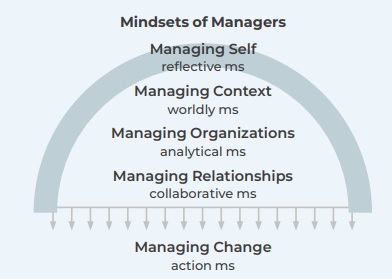
With the basic building block of the session and a library of guidebooks, we have the pieces in place from which to create a leadership development program. Henry Mintzberg and Jonathan Gosling’s five mindsets framework provides the foundation and scaffolding.
Leadership development initiatives tend to begin with a familiar formula: define competencies/skills, deliver content, measure outcomes. The underlying assumption is that good leadership can be developed through the accumulation of skills and applied as needed.
But the realities of daily organizational life rarely unfold in a predictable, linear manner. Managing and leading are riddled with contradiction, uncertainty, and ambiguity. In these complex contexts, technical competencies aren’t enough. Leaders must be able to manage paradox and discern how to move within it. This is where the five mindsets conceptual framework, created by Henry Mintzberg and his colleague, Jonathan Gosling, offers a crucial reframing for leadership development.
The framework encourages synthesis rather than separation. The mindsets—reflective, analytical, worldly, collaborative, and action-oriented—change the learning focus from acquiring competencies and skills to developing capacities.
First is the reflective mindset.
“We had the experience, but missed the meaning, ng” begins the Four Quartets, by poet T.S. Eliot.
Without reflection, we miss the meaning of our experiences and the opportunity to learn from them.
This goes beyond introspection; it means seeing yourself so you can understand how you see outside of yourself. It means mulling things over and digging deeper to understand why things happen the way they happen in the organization.
This is about pausing, even for just a moment, to thoughtfully consider actions, perceptions, and assumptions, allowing events to become learning.
Next, the analytical mindset helps managers make sense of data, detect patterns, and reason with clarity. It is about breaking down complexity, but beyond rigid metrics to deeper inquiry.
The worldly mindset invites openness to cultural, political, and contextual realities, resisting one-size-fits-all approaches. It fosters an appreciation that what works in one context may fail in another due to cultural or relational nuance.
The collaborative mindset understands that organizations are social systems, where coordination and negotiation are crucial. It is about establishing conditions for others to get things done, focusing on the relationships and dynamic interactions between people.

The action, or catalytic mindset, ensures ideas translate into things getting done, not just discussed. Effective action emerges from an awareness of the terrain and the team’s capabilities. It catalyzes change and generates movement and results.
The power of this framework lies in the integrative nature of the mindsets. Action without reflection is reactive; reflection without analysis can spiral; analysis without worldliness yields abstract conclusions; collaboration without action becomes just talk.
We have created over 100 guidebooks in collaboration with over 70 different management and leadership thinkers and academics. The library of guidebooks is organized around the mindsets, ts, giving us about 20 guidebooks per mindset. When designing a five mindsets program, designers select 3 to 6 guidebooks per mindset to create a 15 to30-sessionn management and leadership program.
One of the first in-house five mindsets programs was implemented in Japan in 2008.
A Peer Coaching Group Five Mindsets Program at Fujitsu SSL.
Fujitsu Social Science Laboratory (SSL) is a key player in system consulting and integration services in Japan. In the early 2000s, managers struggled with strategy development, innovation, poor information-sharing, and a lack of development for their junior employees. Recognizing these gaps, an innovative human resources development manager turned to the Reflection Round Table (RRT) program. They aimed to enhance managerial skills, foster the development of junior staff, reduce bureaucracy, and facilitate robust information sharing within the organization.
The program was structured around the five mindsets. This ensured that development was not siloed but rather integrated and holistic. For each mind, there were six sessions, totaling 30 sessions.
Participants were divided into cohorts of twelve participants with one facilitator. During the sessions, the twelve participants were divided into three peer coaching groups, with four participants per group. Sessions were held weekly in the mornings over six to nine months.
A distinctive element was the facilitator selection process. At first, the program was facilitated by external facilitators. By the second year, facilitators were chosen from previous program participants, often individuals in higher-ranking positions. This cascade model not only scaled the program cost-effectively but also provided participants with practical, in-context advice from experienced internal leaders, fostering a strong mentoring environment. Senior leaders learned as much from facilitating as participants did from their guidance.
The program was customized with elements like Zen meditation and Zazen practices to enhance focus and self-awareness, drawing from traditional practices such as Kendo and tea ceremonies to broaden perspectives and challenge assumptions. This contextualization of Japanese culture was vital to the program’s deep impact and acceptance within the organization.
Initially, the peer-based, reflective approach met with scepticism. Managers, accustomed to traditional, lecture-style training, questioned the efficacy. “How can real learning happen in short sessions?” was a common refrain. However, within a few months, participants began arriving early, eager to engage in the session. There was a significant shift in participant attitudes.
The positive results were substantial and measurable, proving its deep impact:
High Engagement & Satisfaction: The program boasted impressive attendance rates of 93% and participant satisfaction rates of 96%.
Improved Management Practices: Participants reported significant improvements in strategic thinking, adopting a broader organizational perspective, and increased focus on people development.
Enhanced Communication: The program fostered more open dialogue, leading to an increase in informal “chat kitchen talks” and discussions about long-term vision, indicating a positive shift in the organizational culture.
Increased Profitability: While not explicitly causal, a correlation was observed between participation in the peer coaching groups program and improved profitability, suggesting the program empowered managers to drive business results through enhanced people development.
Group Company Collaboration: The program fostered collaboration across different Fujitsu group companies, leading to joint projects and strengthened inter-organizational relationships.
Enough Leadership. Time for Communityship.
(republished with permission from Henry Mintzberg – mintzberg.org/blog/communityship)
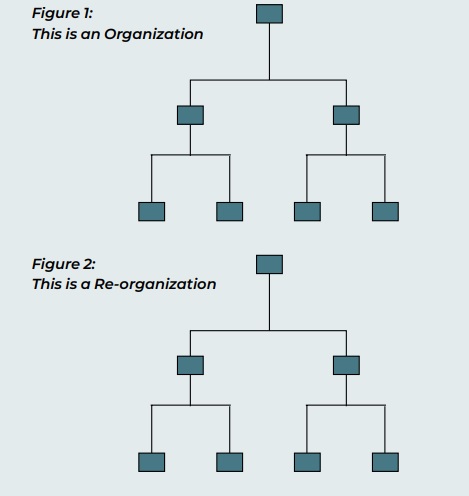
Heard the word “leadership” lately, for example, in the last five minutes? We are obsessed with leadership: say organization, and we think leadership. That’s why those organization charts are so ubiquitous. They tell us who sits on top of whom, but not, for example, who talks with whom? Must we be so fixated on formal authority? (Have a look at Figure 1 to see an Organization. Then look at Figure 2 to see reorganization.)
Ever heard the word “communityship”? If not, fear not: you won’t find it in a dictionary.1 Too bad, because we need it to put leadership in its place.
Say “leadership” and you invoke the image of an individual—at the limit, the great white knight riding in on a great white horse to save us all (even if headed into a black hole). Everyone else is a follower. Even though lleadersintendsttoowerthetpeoplelee, its effect can be to disempower them. Do we really want a world of followers?
Think of the organizations you most admire. I’ll bet that front and center is a powerful sense of community. To use a phrase that I cannot repeat too often, effective organizations are communities of human beings, not collections of human resources.
How can you recognize communityship? That’s easy. You have found it when you walk into an organization and are struck by the energy in the place, the personal commitment of the people, and their collective engagement in what they are doing. These people don’t have to be formally empowered because they are naturally engaged. The organization respects them, so they respect it. They don’t live in mortal fear of being fired en masse because some “leader” hasn’t made his or her numbers. Imagine an economy made up of such organizations.
Sure, we need leadership, especially to establish community in a new organization and to help sustain it in an established organization. What we don’t need is this obsession with leadership—of the individual singled out from the rest, as if he or she is the end-all and be-all of the organization. So here’s to less leadership, or perhaps better put, just enough leadership, embedded in communityship.
There is a famous line in a Molière play spoken by a character who discovers that he has been speaking prose all his life. Well, it’s time for us to discover that the best of our organizations have been living communityship all their lives.
This program at Fujitsu SSL demonstrates how peer coaching groups with content, when thoughtfully structured around the five mindsets framework, result in an effective leadership development program.
Finally, the program also creates Communityship because of the learning approach and program structure.
In peer coaching groups, e, every member brings valuable insights and challenges to the table. Knowledge is co-created through dialogues, reflection, and shared problem-solving. As participants engage in structured, yet open-ended, conversations about real work challenges, they build trust, foster psychological safety, and cultivate a sense of belonging. This results in a more human, connected, and resilient organization with improved operational performance because, as Henry Mintzberg likes to state:
"I'm a human being not a human resource. Organizations are communities of human beings, not collections of human resources." By focusing on the human beings, a five mindsets program using coaching groups drives both individual and organizational transformation.