








This Idea can be purchased for personal use only here
Peter Drucker, often thought of as 'the father of modern management', wrote hundreds of books and articles. They shine with wisdom and wit, to-dos and not-to-dos, historical reflection, and modern insights. It is all worth reading, thinking about, and applying. Yet the sheer volume of his work, however useful, makes it both daunting and difficult to fully grasp the fundamentals of his breadth of thinking, both for management scholars and practising managers.
Drucker himself compiled selected parts of his writings into new books such as The Essential Drucker and A Functioning Society. Others have compiled Drucker's works, like Joe Maciariello's The Daily Drucker. Yet until now there has not been a succinct set of Drucker Principles. This series created by the Drucker Institute at Claremont Graduate University is just that.
Each article in the series is true to Drucker: practical and pragmatic for an active leader, including principles and policies. A principle is a basic truth or assumption that guides actions during uncertainty. A policy puts a principle into actionable terms, guiding actions with greater certainty.
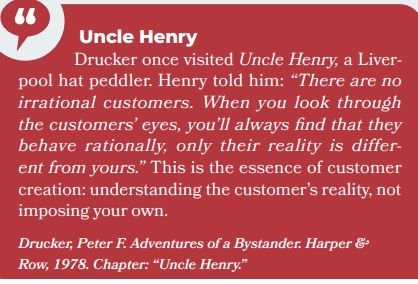
In this issue, we take a look at the principle of customer-centricity.
Drucker's most radical idea overturns the comforting illusion that organizations exist to make products, deliver services, or generate profit. They exist for one reason only: to create a customer.
WHY IT MATTERS
This principle shifts the focus from what the company wants to sell to what the customer values. It requires constant inquiry into who the customer is and what their unmet needs are.
This is Drucker's most radical idea. It overturns the comforting illusion that organizations exist to make products, deliver services, or generate profit. They exist for one reason only: to create a customer, someone who sees value in what you offer and chooses you over alternatives. Everything else is derivative. As Drucker wrote, "It is the customer who determines what a business is."
This Principle forces leaders to abandon inward definitions of purpose. The organization's reality is not the internal plan, the internal brilliance, or the internal belief. The only reality that matters is the customer's. And as Drucker warned, "What the customer considers value is so complicated that it can only be answered by the customer." When leaders forget this, they drift into self-absorption, confuse activity with purpose, and ultimately lose relevance.
WHAT IT MEANS IN PRACTICE
• Start with the customer's world, not your product. Needs exist before solutions.
• Value is defined externally. Only the customer can say what matters.
• Stakeholders are customers too. Employees, suppliers, regulators, investors all must experience value.
• Customer creation precedes business creation. Entrepreneurs don't start with ideas; they start with unmet needs.
• Markets evolve. Customer needs shift with technology, regulation, and experience. Standing still is choosing obsolescence.

WHAT LEADERS MUST DO
1. Clarify the customer
Define the primary customer, the purchaser, and the secondary customers whose needs shape your ability to serve the primary one. The organization must create value for all customers. This clarity prevents the common error of designing for everyone and satisfying no one.
2. Test from the outside
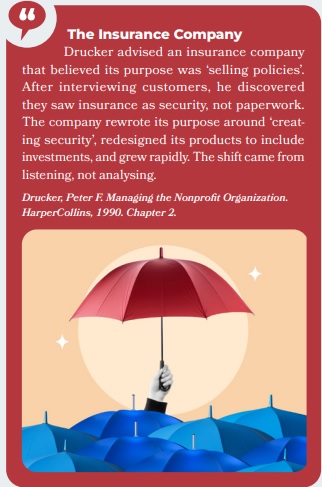
Ask customers what results they expect. Ask former customers why they left. Ask prospective customers why they have not chosen you yet. Drucker warned that failing to ask leads to the 'grave error' of substituting internal judgement for the customer's judgement. The only cure is disciplined, repeated, humble inquiry.
3. Ban inward definitions
No mission statement may define purpose in terms of internal excellence: manufacturing, sourcing, marketing, innovation. These are means, not ends. Purpose must be defined from the outside in: what the customer values, needs, and is willing to pay for.
4. Build for change
Customer needs evolve. Technology reshapes expectations. Regulation shifts incentives.
Familiarity changes what customers consider 'good enough'. Organizations that do not evolve with their customers become irrelevant to them.
PITFALLS & MISCONCEPTIONS
1. Mistaking data for understanding
Metrics are necessary but insufficient. Having data may make you believe you know the customer, but data describes behaviour; it does not explain motivation. Only customers can do that. Learning from them is never-ending.
2. Overcustomizing
An internal review at a telecoms company traced a major customer crisis back to a decision made years earlier. An ambitious salesperson, eager to win a very large contract for thousands of phone lines, had secured the deal by offering unusual pricing and pushing the technology team to build a bespoke billing process for that one customer. The extra complexity was tolerated at the time because the sale looked worth it. But over the years the workaround became a serious operational problem and eventually threatened the customer relationship itself.
When the issue was finally explained to the chief executive, he fell silent: he had been the salesperson who made the original deal. The lesson is straightforward. The cost of pleasing one customer must never undermine the ability to serve all customers.
3. Confusing the product with the need
Customers don't buy drills; they buy holes. They don't buy iPhones; they buy communication, identity, convenience, status. They don't buy booklets; they buy clarity, confidence, and capability.
THE DRUCKER QUESTION
What is best for the customer? This question ends arguments, clarifies priorities, and forces leaders to look outward where purpose actually lives.


